Showing posts with label D4Dementia. Show all posts

Wednesday, 20 May 2020

D4Dementia has moved!

Please visit: http://www.d4dementia.com

If you subscribe to my blog, please re-subscribe on the new website, thank you.

Monday, 20 May 2019

D4Dementia 7th Birthday

On 20 May 2012, I began D4Dementia with this simple introductory post: Welcome to D for Dementia.


Since then the blog has been read by thousands of people around the world, and I’ve had countless comments, requests for help and stories shared via email or social media. For every person who has ever read my blog, or taken the trouble to share it or comment on it, thank you. I appreciate all of your amazing support.

In preparing for D4Dementia’s 7th birthday, it occurred to me that I'd never actually asked my readers what you think of the blog in an organized, analytical way. So I created and published a 5-question survey on 20 April 2019 to gather that feedback. 

Thank you to everyone who completed the survey. I’ve loved reading your responses and want to share some of the information I’ve gathered.

Firstly, I asked how often you read my blog – almost every respondent said monthly, which is fantastic considering I publish a new blog monthly. Then I asked if you had a favourite post on D4Dementia. Most respondents didn’t, but those who added an optional comment pointed to posts including the following:


Then I asked for your comments on D4Dementia. These are a selection:

Question 4 asked what is most important to you in blog content. You can see the answers below, with 'Providing practical solutions' and 'Drawing on personal experiences' as the most popular choices.


Finally, my last question asked about topics you’d like me to cover in future blogs. Some of the suggestions that were made have already been put into my workplan, but to address two comments that I probably won’t be writing stand-alone blogs about:

"I'd like to know more about your work and impact in the sector."

Please see my website for more information.

"More about co-housing with students/young people."

I would suggest reading about the work of Homeshare and Shared Lives Plus.

Huge thanks once again to everyone who reads my blog and everyone who contributed to the survey. I hope you continue to enjoy D4Dementia, and please do keep in touch with your comments, queries or questions.

Next up, my Dementia Action Week blog: 'We are family'.

Beth x


You can follow me on Twitter: @bethyb1886
Like D4Dementia on Facebook

Monday, 12 December 2016

200 not out

I never thought I'd be writing this, but this post is my 200th on D4Dementia!

What began as a modest blog with an ambition to share some of the experiences (mostly positive) that we'd had with my dad during his 19 years with vascular dementia has taken on a life of its own, and despite all of my other work which arguably takes up more of my time now, I am still known very much as a 'blogger' and proud to be so.

As I've come to learn since 2012, blogging has an important role to play in dementia care and support. This blog has enabled me to share experiences that I would otherwise never have shared, and because it's freely available to anyone with a device and an internet connection it reaches people across the UK and beyond, something I couldn't do consistently through any other media.

I've learnt from tracking my audience that the posts you all like the most are the ones that give really practical advice, and if anything I'm mindful that I need to write more of those in the future. Helping people who are affected by dementia has always been my prime motivation in everything I do, and my blogging is perhaps the most accessible way that I can do that.

I also know from feedback that this blog is as loved by people living with dementia and their families and friends as it is professionals who, despite the raised profile of dementia and the increased focus on dementia training, still look to the internet to provide them with the information, advice and support that they need to do their jobs to the very best of their ability.

Amongst the millions of words I must have written for this blog, experience has taught me that some are more powerful than others. Sometimes a really punchy quote shared via social media is what ensures a blog post reaches the people it really needs to. It may be because the words express something that a person feels but cannot express themselves, the sensation of solidarity or comfort in what they've read, or because a quote sparks a thought or action that, ultimately, improves a service for people who are living with dementia and their families/carers.

So, in the spirit of sharing that's associated with this Christmassy time of year, here are some quotes from 5 of my 200 blog posts that give a glimpse into the passions behind my work:

“Everything my dad went through is there to inform, educate and influence others – I believe he would have wanted to make a real and lasting difference, and I hope that will be his legacy.” From ‘My dad’.


“If you had to be isolated, unsupported and fight the system, would you apply to be an unpaid carer?” From ‘The carer’s job description’.


“Dementia takes so much from a person, but anyone who treats an adult like a child takes far more.” From R-E-S-P-E-C-T’.


“Above all else, remember this: care homes are for caring, prisons are for punishment.” From ‘From care to catastrophe’.


The only true representation of each person’s unique experience of living with a diagnosis of dementia is from that person themselves. Anything else is a substitution.” From ‘Why don’t we listen to people with dementia?’


So, what next for D4Dementia? Given the growth in other areas of my work I've decided to abandon my strict fortnightly Monday publishing regime and be a little more unpredictable in my blog posting. There will be at least one blog a month, but beyond that, I reserve the right to be spontaneous, not least because this gives me the option to react to news stories in a much more timely way. To make sure you never miss a blog, sign up to receive them into your inbox (you can do this via the box near the top of every page of D4Dementia) or follow me on Twitter or Facebook.

As a result of my new routine (or rather throwing the routine out of the window!), it will probably take me a little longer to reach my next milestone of 300 posts (my 100th blog was published on 13 November 2013), but I have every intention of reaching that magic 300 and going beyond it. Will I run out of things to write? I doubt it!

Wishing you all a wonderful Christmas and New Year. Thank you for your amazing support in 2016 - Here’s looking forward to 2017!

Until next time...
Beth x


You can follow me on Twitter: @bethyb1886

Monday, 21 December 2015

My top 10 most read blog posts

One element that fascinates me about blogging is which topics get the most attention from readers. There is no particular formula for how I choose what to write about, so to see what becomes most widely read is really informative for me. 

To round-off 2015, I wanted to compile a blog that reflects the posts on D4Dementia that have been read the most. With over 170 entries on a variety of topics relating to dementia, health and social care, there is certainly plenty of subject matter to trawl through, and for me, many fond memories of writing particular blogs.

So (drum roll) here is my top 10 to date:

10 – Think about the ‘Dementia Words’ that you use
Published in May 2015, this post focuses on the language used in relation to dementia, a topic that always ignites passionate responses. The inspiration behind this particular post was the Dementia Action Alliance and DEEP (Dementia Engagement and Empowerment Project) Call to Action entitled ‘Dementia Words Matter’.
 
9 – NCD (Otherwise known as dementia)
Published in November 2012, this post focuses on the drive to change the name of dementia to ‘Major or Minor Neurocognitive Disorder’. Unsurprisingly, as it’s another post focused on language around dementia, it has been a very popular read.
 
8 – Hydrated and happy
Published in May 2013, this is the first of what I’d call my ‘practical advice’ posts to feature in the top 10. Hydration is such a key topic in dementia care, so I'm delighted it has been so widely read. 
 
7 – The carer’s job description
Published in June 2012, this post remains one of my personal favourites. I’ve written extensively about the role of family carers since ‘The carer’s job description’, but I don’t think I’ve ever improved upon how I opened this particular blog: “If you had to be isolated, unsupported and fight the system, would you apply to be an unpaid carer? This is not a position that fills you with hope for the future, gives you room for personal development, or brings the benefits of structured team work. Yet thousands of people fulfil this truly unique role; not because it was their dream job and certainly not because of the bonuses and benefits.”
 
6 – Understanding aggression
Published in July 2013, this is the second of my ‘practical advice’ blog posts to make it into the top 10. Although I’ve never been entirely happy to categorise any dementia symptom as ‘aggression’, largely because I think the bluntness of that language helps to reinforce stigmatised views about people who are living with dementia, I hope the wording is forgiven in favour of some of the really important points in the blog that I wanted to put across in the most straightforward way possible.

5 – End-of-life care: A very personal story
Published in June 2012, this is easily the most difficult blog post I’ve ever written. Discussing my dad’s end-of-life care for the first time was very emotional, and I remember reading the blog back to myself for the first time after I’d written it and the tears streaming down my face.  

4 – Caught on camera
Published in October 2013, this is perhaps the most controversial blog post in my top 10. It explores the use of hidden cameras in care homes, a topic that remains hugely divisive to this day. 

3 – The voices of experience
Published in June 2013, I’d like to think that the inclusion of this blog post at number 3 in the top ten is testimony to the real groundswell of opinion that the voices of people with personal experience of dementia, whether they are living with a diagnosis of dementia or a past or present carer, should always be heard at any and every event about dementia. Sadly I think there is still a long way to go to make this a reality, but since I wrote this post things have moved in a more positive direction around including and valuing personal experiences. 

2 – So how much do you know about dementia?
Published in September 2012, this is another of my personal favourites, a blog post all about busting myths and challenging stigma. I’ve written about dementia awareness many times since this blog post, but the basic messages in this particular piece are as relevant now as they were then. Written before we had ‘Dementia Friends’ and some of the other high-profile awareness-raising initiatives, this was a real trail-blazer blog post for me, and one that I still see referenced on social media.  

And at number one…. 

1 – Hard to swallow
Published in September 2012, I honestly never imagined that when I wrote a blog on dysphagia (swallowing problems) that it would attract such a wide and extensive readership. I suspect the popularity of this post is testimony to the fact that trying to find out essential information about this common aspect of dementia care is difficult for both families and professionals alike. Nothing makes me happier than to know it has been so widely read, and judging by the feedback I’ve received the advice in this blog has been extremely helpful to numerous people from a wide variety of backgrounds.

So there you have it, my top ten most read D4Dementia blog posts. What this list tells me overall is that practical advice really reigns supreme when it comes to blogging about dementia. ‘Hard to Swallow’ isn’t at number one by a narrow margin – to put this into context, it’s been read by as many people as numbers 2-5 combined.  

Of the remaining ‘practical advice’ blog posts in the top ten, I’m not at all surprised to see my blogs featuring tips to keep a person with dementia hydrated and how to understand and cope with aggression are both really popular reads. Just missing out on the top 10 were my blogs on understanding how a person with dementia expresses themselves and how to promote continence and cope with incontinence, which only reinforces in my mind that readers really value the chance to explore our personal experiences as a family, alongside gaining tips and advice for coping themselves.

Of the remaining posts, to see end-of-life care at number 5 proves that a topic so many of us shy away from needs to be tackled, and of course from a personal perspective, to see my first major blog on family carers being so widely read is a real plus point for me. Dementia language and awareness were, I think, always likely to feature given the growing prominence of both issues, and dovetails rather neatly with the messages in my blog post about involving people with personal experience of dementia. Finally, of course, tackling a controversial issue like cameras in care homes inevitably draws attention – hopefully it has also helped to provide some clarity on a topic that divides opinions.

As this will be my last D4Dementia blog post of 2015, all that remains is for me to wish you all a very Happy Christmas and New Year. I hope the festive season brings you joy and many treasured memories. Mine will be my first as a new mum, and I will perhaps reflect on this next year. D4Dementia returns in January, with the first blog post planned to go live on Monday 11 January. 

Thank you for your amazing support during 2015. Here’s looking forward to 2016!
 
Until then...
Beth x


You can follow me on Twitter: @bethyb1886

Monday, 13 April 2015

Happy birthday to my dad

Today would have been my dad’s 88th birthday. By sheer coincidence, this blog is also my 150th on D4Dementia. How I have managed to bring these two milestones together I have absolutely no idea, but it makes this blog post extra special.

For me, today is more about celebration than sadness. That’s not to say that I’m not incredibly sad that I can’t spend the day with my dad, of course I am, although to be fair I think that every day not just on memorable dates. Every April since I began this blog, I’ve written a post about the milestones April brings for us as a family (2013: ‘Reflections on a life lived and a man loved’ and 2014: ‘A loss of innocence’), but this year I want to focus more on how we celebrated today when my dad was alive – happy memories that I will always cherish and that I hope might inspire other families. 
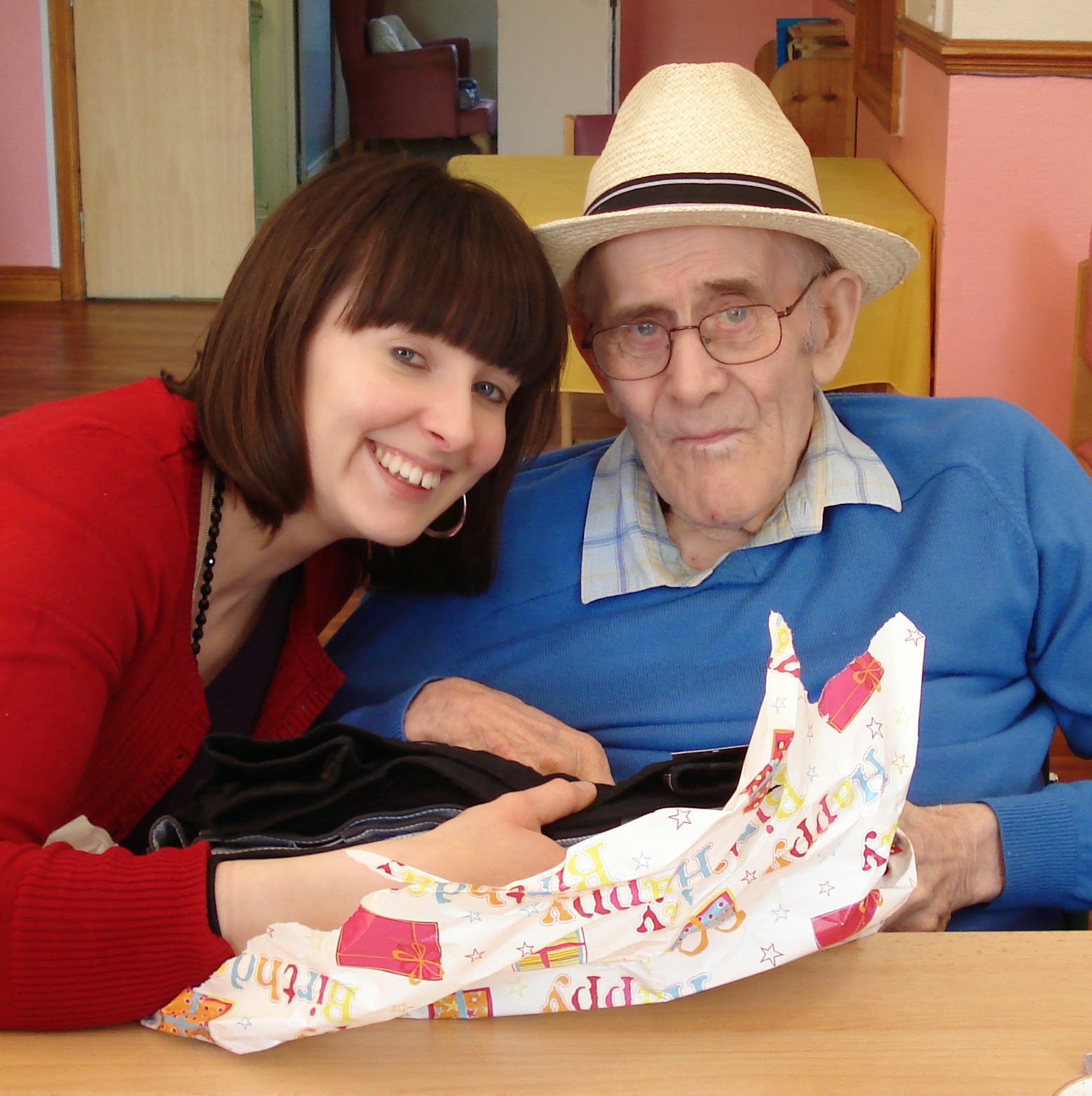
Dad's birthday in 2010
As regular readers will know, my dad spent 9 years in 3 different care homes. That’s 9 birthdays that you might be forgiven for thinking were difficult to even contemplate celebrating, given that dad was living in a communal environment and over the years became very immobile and poorly, severely restricting what a celebration could actually involve.

Yet quite the opposite is true. We made the best of the situation we found ourselves in for three reasons:  

·       Firstly and most importantly for dad. He didn’t ask to have dementia, nor, given the choice (we weren’t) to live in care homes. He was never the biggest fan of his birthday but, that said, in my early childhood dad always had a cake, special meal, favourite drink, cards and presents, and frankly, there was absolutely no reason not to carry on with those celebrations as best we could.

·       Secondly, to make the most of family time together. Despite dad living in a communal environment and sharing his birthday celebrations with everyone living there, it was also a landmark date for us getting together as a family and in amongst all the other faces and events happening around us we still had quality time together as a family.

·       Thirdly, to create the happy memories and photos that we have today. This reason seemed less important at the time, we were simply living in the moment, but now that dad has gone it takes on a very different meaning.
 
The nature of dad’s birthday celebrations changed over those 9 years. To begin with we would take dad out, go to the pub and have a favourite meal and a pint, most notably for dad’s 80th birthday. I have a fabulous picture that I occasionally show during presentations at conferences of my dad enjoying his pint on his 80th birthday – a photo that for me really sums up living well with dementia.

Subsequent birthdays were spent at the care home. Dad had a swallowing problem for the last 4 years of his life which made eating out quite difficult. Food choices were very restricted for him on conventional menus, and given that his routine was to have his main meal in the middle of the day, options such as soup really weren’t going to be enough for a man who, gloriously, still had a very impressive appetite.

Just because dad couldn’t go out for a meal, however, didn’t mean that we couldn’t all eat together. We would talk to the chef at the care home prior to dad’s birthday and as a family we would each choose something to eat with dad. A family table would be set in the dining room and we’d enjoy a two course meal with dad. Sadly we never had much success thickening beer, and dad didn’t like the taste of wine in the last few years of his life, so the toast became fruit smoothies.

Generally before lunch we would open presents and cards, not least because dad would often be too sleepy to enjoy them in the afternoon. A standard present was always a new CD, and that would usually be played in the afternoon. As dad liked lots of classical music, it was very easy for us all to get into the spirit of an afternoon nap! I would often be propping my eyes open sewing name tapes into dad’s new clothes (another standard birthday present), before cake arrived.
Dad's 2011 birthday cake
Like many care homes, the homes my dad lived in always gave residents a freshly baked cake for their birthday, complete with candles to blow out. I would also make a cake, and we would share tea and cake with dad mid-afternoon, and then by 4.30-5pm the evening tea would arrive – usually soup, sandwiches and a dessert.
 
Suffice to say, then, that dad’s birthdays were pretty much crammed full of food, along with lots of photos, singing, laughter, smiles and jokes. I would always ask dad if he liked his presents, and it was always his prerogative to say he didn’t – a little joke between us that always made me smile.
 
Birthdays, with the exception of dad’s last birthday, were always happy events, so much so that as I write this I have a smile on my face. Sadly, for dad’s last birthday, he was very poorly and would pass away less than two weeks later. Those photos aren’t happy ones, and those memories have a very strange mix of emotions attached to them. Gratitude and relief that dad’s last birthday wasn’t spent in hospital, huge thanks to the wonderful staff at the care home dad had just moved into for their help in getting him out of hospital and the huge effort they made on the day with decorations and a beautifully decorated cake (that unfortunately dad was too poorly to eat), but also recollections that no matter how much we tried to lighten the mood, we knew that dad wouldn’t be with us much longer.
 
Although those memories may be the last ones I have of my dad’s birthdays, the happy times we had in earlier years outweigh the sadness, and I hope that they give other families some inspiration to continue to celebrate and enjoy special occasions with their loved ones. Living with dementia, and indeed living in a care home, doesn’t have to end all hope of putting the ‘Happy’ into ‘Happy Birthday’.
 
Until next time...
Beth x


You can follow me on Twitter: @bethyb1886


Wednesday, 18 December 2013

Reflections on 2013

Reflecting on a whole year is never an easy task. So many different events, milestones, and most importantly people have contributed to the last 12 months, each leaving me with that most precious gift – a memory.

My collection of memories for 2013 is fairly eclectic – I’ve spoken at conferences, run workshops, taken part in debates and appeared on radio and TV. I’ve become a Dementia Friends Champion and a member of the Dementia Action Alliance, as well as fundraising for Dementia UK and Alzheimer’s Society. I’ve become an Ambassador for BRACE, won ‘Best Independent Voice on Older People’s Issues’ at the Older People in the Media Awards, and made a film that was shown at the first ever G8 Dementia Summit.

Attending the Summit, and having tea with the Prime Minister afterwards, is arguably the most high-profile memory of 2013, but could it also be the one that has the most impact in the years ahead? I was asked after the Summit whether I thought the G8 would stick to their commitment to, “Find a cure or disease-altering therapy by 2025.” My answer is that it is up to all of us who are passionate about dementia to ensure that they do.

But for this, my last D4Dementia blog post of 2013, I want to share some memories with you that aren’t going to make huge headlines but will live in my heart and mind for a long time. So, in no particular order:

Meeting Kate Swaffer: Arguably the greatest privilege of the year, and certainly one that I’ve spoken about extensively since, was meeting Kate, an online friend who became a real life friend over a #dementiachallengers lunch in London. Kate’s grace, poise, humour, kindness and wisdom is inspirational - she also happens to be living with dementia. Kate, along with the lovely people who featured in the G8 films (Hilary, Trevor and Peter), are shining a vital light into what living with dementia REALLY means.
Moral of the story: Think myths and stigma about dementia and then think again.
Our Memory Café:  It’s been a tough year for dementia services in my area. Our Singing for the Brain (SFTB) closed down, and our Memory Café is mostly being propped up by people attending from the local care home. Alongside the sadness of hearing about the deterioration of some of our friends from SFTB, came the joy of seeing ladies from the local care home singing along to some of their favourite tunes at our impromptu music group at the Café. As one of the ladies said, “I thought I was only going to get a cup of tea. I didn’t know we would have singing too. Thank you so much.”
Moral of the story: Sometimes the small things in life bring the most pleasure (and don’t require huge sums of money to deliver).
My dad’s last care home: I’m somewhat ashamed to admit that since we cleared out my dad’s room following his death in April 2012, we hadn’t been back to the care home that looked after him in the last two weeks of his life. That isn’t because we didn’t want to, but despite the loveliness of the home I still picture answering the door to the undertakers and seeing dad being wheeled out of the home on their trolley. However, when I was asked if I could show a colleague from NHSIQ around a good care home, there was nowhere else I could have taken her. It was emotional to be back there again, but the huge smiles, hugs and warm welcome from the amazing people working at the care home reminded me yet again what a special place it is.
Moral of the story: For all the negative reports you hear about social care, there are far more good places and people that are never spoken about.
Finally…
People: I’ve met such a huge array of people this year – politicians, health and social care professionals, managers, civil servants, business owners, academics, families from all walks of life, and many inspirational people who are living with dementia. From the youngest to the oldest, from those who are extremely knowledgeable about dementia to those who feel completely baffled and are desperately seeking help, it’s fair to say that each and every person has managed to inform and educate me in some way.
Moral of the story:  We all have something to offer, and to dismiss others is to do ourselves a great disservice.
So, it is with my precious collection of memories from 2013 that I close this blog post by wishing you all a very happy Christmas and a peaceful, healthy and fulfilling 2014. My next D4Dementia blog will be in January, and I’ve taken the difficult decision that D4Dementia will become fortnightly from next year, so suffice to say it will take me somewhat longer to reach my next century of blog posts. What won't change, however, is my passion for raising awareness of dementia, tackling 'difficult' topics, and providing positive and practical advice.
Thank you all for your amazing support over the last 12 months.
Until 2014...

Beth x


You can follow me on Twitter: @bethyb1886

Wednesday, 13 November 2013

100 not out

Back when I began D4Dementia I have to admit I never thought I would make it to 100 blog posts. Indeed I was unsure I would make it to 10, and even more unsure if anyone would actually want to read them!

How wrong I was. My humble little blog has become beloved by thousands, and I am eternally grateful for the support of each and every one of you, whether you are a one-off reader, an occasionally viewer or a regular to these pages.

Despite the fact that many months have passed since my first post, and so many exciting things have happened for me in that time, the values, passion and dedication that persuaded me to start D4Dementia remain as strong as ever.

Back on 20th May 2012 I told you that following my dad’s passing just a month earlier after 19 years with dementia, I was on a quest to, “Provide support and advice to those faced with similar situations, inform and educate the wider population, promote debate, and campaign for improvements in dementia care and changes to the care system in general.”

My appraisal of this, on my 100th D4Dementia blog post, is that this quest is coming along nicely. I’ve learnt that I will never succeed 100 percent with any of these aspirations no matter how successful and sought after my work becomes, simply because life is about learning and sharing and reaching every single person, family, professional and organisation will always be tantalisingly beyond reach. But that is exactly how it must be, since to fully succeed would be to stop trying, and I don’t ever plan on doing that.

I’m not sure if my passion in itself is unique, or simply just uniquely driven, but I know it is heartfelt and sincere, and no matter how many years separate me from the day of my dad’s passing, he will always be the focal point for everything I do. He gave me so much to be proud of in him as a father, a man, a role model and a person living with dementia – nothing can or ever will erase those memories.

As D4Dementia has grown in popularity, so more doors have opened for me, and I’m very excited about what 2014 holds for my work. There have been a few references to my ‘celebrity’ and ‘fame’ recently – all highly embarrassing. I’m just a normal girl, from a very humble background, sharing my experiences and trying to make a difference. That is not to underestimate my determination, but not to overstate my view of myself either. Hard work, humility and respect were my dad’s watchwords and they will always be mine.

So I guess the only way to conclude this post is to raise a glass to another 100 D4Dementia blog posts – right now I’m unsure they will ever happen, but then I’ve been wrong before!

Keep reading, enjoying, learning, sharing links and recommending D4Dementia, and I promise I will endeavour to keep on making all of those activities worthwhile. With your support everything is possible.

Thank you.

Until next time...
Beth x


You can follow me on Twitter: @bethyb1886

Wednesday, 7 November 2012

My dad

My dad
My dad
Welcome to my 40th post on D4Dementia. Back when I began this blog I had no idea it would become so successful, widely read and much loved, so I would like to thank each and every one of you for reading D4Dementia, spreading the word about it, sharing your stories with me and supporting my work so wholeheartedly, it is much appreciated.

My aim for D4Dementia is that it represents a place where those who have dementia or care for someone with it can find solidarity, support, help and advice, whilst also being a source of insight for professionals working in dementia care and policy makers tasked with improving the lives of everyone living with dementia. As I have said previously,  everything my dad went through is there to inform, educate and influence others – I believe he would have wanted to make a real and lasting difference, and I hope that will be his legacy.

Sadly the many people who have read about my dad’s dementia journey will never have the chance to meet him, so you will have to take it from me just what a down-to-earth, kind, loving, charismatic, funny and unassuming man he was. He worked hard but never played hard, he loved his family, animals, nature and the countryside, spent his spare time reading books, listening to music and singing songs (he had a beautifully rich, deep voice), enjoyed watching football, cricket and rugby, never travelled abroad, always loved his Sunday roast (especially when it was beef and Yorkshire puddings), believed in goodness, fairness and truth, and taught myself and my siblings so many values, most notably concerning dignity and respect, all underpinned by the simple idea that you treat others as you would wish to be treated yourself.

My happy childhood with my parents never extended into my teens and twenties – dementia crept into our world when I was about 12 years old, and over the following 19 years changed everything about my relationship with my father. Now I visit his grave when only a few months previously I visited his care home. Just over a year ago we had an amazingly happy family day out at a local woodland, a place I returned to this week. As I walked through the carpet of leaves, I reflected on that visit with dad and how the abundant happiness on that day is even more powerful now that it was then.

I think you only truly realise just how precious those times are when you know you can never have them again. It is so easy to see dementia as a reason to just ‘get through the day’ – do what you have to do for your loved one, deal with all those problems and issues that occur on a daily basis, and forget in the process to just live in the moment. Take in the good things (they are there, some days you just have to look harder for them), work through the difficulties (not allowing them to obscure everything else) and allow yourself to feel and express your emotions, never bottle them up.

Above all, when you care for a loved one with dementia, remember that they are still a part of you. Even now, with my dad passed away, so much of what made him my dad is in me – not least his love of writing. He dabbled in it for many years during my childhood and I think he would wholeheartedly approve of my career choice as a result. His qualities are something I try to bring to my work and my life, but even more than that, they represent the foundations of good dementia care.

My father was actually never a man who sought or enjoyed the limelight. He was self-deprecating, never wanted a big fuss on his birthday or at Christmas, would always try and stand at the back in a photograph, and was happiest watching and supporting those he loved. Yet interestingly, though his writing, he had a steely and sadly unsuccessful desire to tell his story – the story of his youth, of the landscapes and animals that shaped it, and the love he had for a life that was gone but never forgotten.

When dementia intervened in our lives it focused dad’s mind once more on those long lost days before it took him from us, leaving his more recent story to be told. So here’s to another 40 posts on D4Dementia, many more readers along the way, and most of all to my dad – an amazing man who taught me so much and I hope will teach others even more.

Until next time...

Beth x


You can follow me on Twitter: @bethyb1886