Showing posts with label celebrations. Show all posts

Saturday, 23 May 2015

Do something new... and celebrate

Welcome to the last of my seven blog posts for UK Dementia Awareness Week 2015.

This year's Dementia Awareness Week centres around the theme of doing something new for people with dementia, under the mantra that ‘Life doesn’t have to end when dementia begins’. For many people living with dementia in care homes, however, a lack of opportunities to have meaningful occupation and activity, or even just enjoy the simple pleasures that many of us take for granted, can lead to life feeling like it really has ended.

Over this Dementia Awareness Week (DAW2015) I want to look at some of the positive things relatives and staff can do to enhance the lived experience of people with dementia in care homes. They may be new things, or they may be old favourites, but they all share in the ability to turn a boring day into something a little bit more special.
 

Day 7: Celebrations

Most care homes I’ve been involved with, either personally through my dad or other family and friends or professionally through my work, are good at helping residents to celebrate their birthdays. The joy of a decorated cake with candles and a cuppa was a yearly event for my dad, but there is so much more that we can do with celebrations.

Birthdays and Christmases are the obvious examples of celebrations, but wedding anniversaries or new grandchildren (or great grandchildren) are also reasons for people with dementia in care homes to want to celebrate. We can go a lot further too, because celebrations aren’t just about the personal, they can be national celebrations too.

Dates like Valentine’s Day and Easter are easy to celebrate, but what about following national events like general elections, royal occasions, commemorations, major sporting events (examples include the Grand National, Wimbledon, the British Grand Prix, the Ashes, the Six Nations Rugby and football's showpieces like the FA Cup or the World Cup Final). Many of these events are freely available on terrestrial TV, but even if there is something on SKY TV that you don’t have access to, why not look out for a late-night terrestrial TV highlights package to record or get the papers the next day and make a collage of the coverage?

How many people, for example, would love to watch Match of the Day, the Last Night of the Proms or the Festival of Remembrance but are already in bed by the time they are televised? It wouldn’t take much effort to record them and make them available the next day for anyone wanting to see them.

Time often passes slowly in a care home, and without constant orientation to the day and time many people lose track of what day, week, month or year they are in. Most of us in that situation would do likewise. But by marking celebrations and major events, it provides the milestones that help to keep the sense of time and place that so many of us take for granted.


More information, tips and advice on celebrations can be found in the following D4Dementia blog posts:

Keeping it relevant: http://d4dementia.blogspot.co.uk/2012/10/keeping-it-relevant.html

Christmases past and present: http://d4dementia.blogspot.co.uk/2012/12/christmases-past-and-present.html

Happy birthday to my dad: http://d4dementia.blogspot.co.uk/2015/04/happy-birthday-to-my-dad.html

Until next time...
Beth x


You can follow me on Twitter: @bethyb1886

Monday, 13 April 2015

Happy birthday to my dad

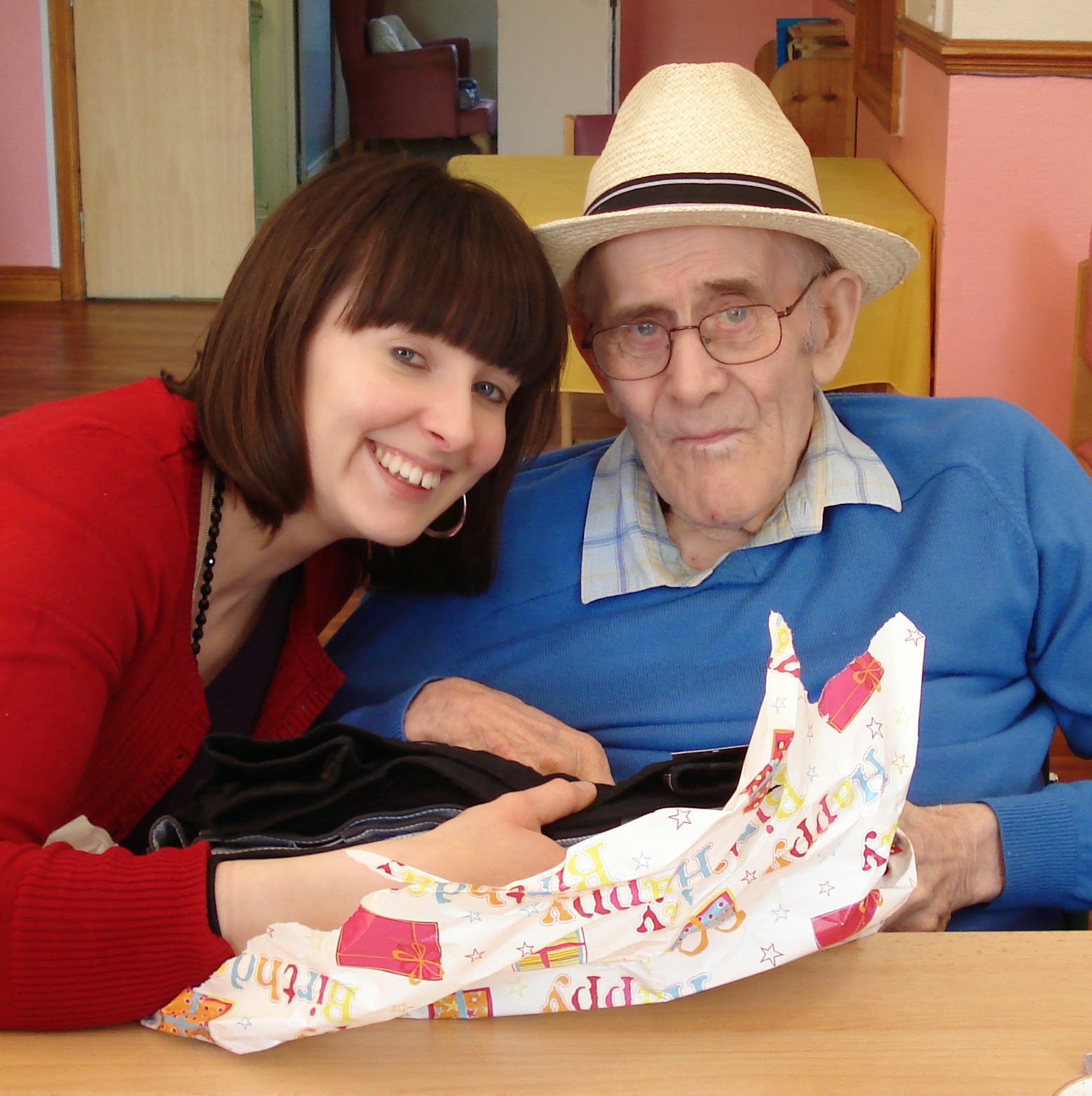
Today would have been my dad’s 88th birthday. By sheer coincidence, this blog is also my 150th on D4Dementia. How I have managed to bring these two milestones together I have absolutely no idea, but it makes this blog post extra special.

For me, today is more about celebration than sadness. That’s not to say that I’m not incredibly sad that I can’t spend the day with my dad, of course I am, although to be fair I think that every day not just on memorable dates. Every April since I began this blog, I’ve written a post about the milestones April brings for us as a family (2013: ‘Reflections on a life lived and a man loved’ and 2014: ‘A loss of innocence’), but this year I want to focus more on how we celebrated today when my dad was alive – happy memories that I will always cherish and that I hope might inspire other families. 
Dad's birthday in 2010
As regular readers will know, my dad spent 9 years in 3 different care homes. That’s 9 birthdays that you might be forgiven for thinking were difficult to even contemplate celebrating, given that dad was living in a communal environment and over the years became very immobile and poorly, severely restricting what a celebration could actually involve.

Yet quite the opposite is true. We made the best of the situation we found ourselves in for three reasons:  

·       Firstly and most importantly for dad. He didn’t ask to have dementia, nor, given the choice (we weren’t) to live in care homes. He was never the biggest fan of his birthday but, that said, in my early childhood dad always had a cake, special meal, favourite drink, cards and presents, and frankly, there was absolutely no reason not to carry on with those celebrations as best we could.

·       Secondly, to make the most of family time together. Despite dad living in a communal environment and sharing his birthday celebrations with everyone living there, it was also a landmark date for us getting together as a family and in amongst all the other faces and events happening around us we still had quality time together as a family.

·       Thirdly, to create the happy memories and photos that we have today. This reason seemed less important at the time, we were simply living in the moment, but now that dad has gone it takes on a very different meaning.
 
The nature of dad’s birthday celebrations changed over those 9 years. To begin with we would take dad out, go to the pub and have a favourite meal and a pint, most notably for dad’s 80th birthday. I have a fabulous picture that I occasionally show during presentations at conferences of my dad enjoying his pint on his 80th birthday – a photo that for me really sums up living well with dementia.

Subsequent birthdays were spent at the care home. Dad had a swallowing problem for the last 4 years of his life which made eating out quite difficult. Food choices were very restricted for him on conventional menus, and given that his routine was to have his main meal in the middle of the day, options such as soup really weren’t going to be enough for a man who, gloriously, still had a very impressive appetite.

Just because dad couldn’t go out for a meal, however, didn’t mean that we couldn’t all eat together. We would talk to the chef at the care home prior to dad’s birthday and as a family we would each choose something to eat with dad. A family table would be set in the dining room and we’d enjoy a two course meal with dad. Sadly we never had much success thickening beer, and dad didn’t like the taste of wine in the last few years of his life, so the toast became fruit smoothies.

Generally before lunch we would open presents and cards, not least because dad would often be too sleepy to enjoy them in the afternoon. A standard present was always a new CD, and that would usually be played in the afternoon. As dad liked lots of classical music, it was very easy for us all to get into the spirit of an afternoon nap! I would often be propping my eyes open sewing name tapes into dad’s new clothes (another standard birthday present), before cake arrived.
Dad's 2011 birthday cake
Like many care homes, the homes my dad lived in always gave residents a freshly baked cake for their birthday, complete with candles to blow out. I would also make a cake, and we would share tea and cake with dad mid-afternoon, and then by 4.30-5pm the evening tea would arrive – usually soup, sandwiches and a dessert.
 
Suffice to say, then, that dad’s birthdays were pretty much crammed full of food, along with lots of photos, singing, laughter, smiles and jokes. I would always ask dad if he liked his presents, and it was always his prerogative to say he didn’t – a little joke between us that always made me smile.
 
Birthdays, with the exception of dad’s last birthday, were always happy events, so much so that as I write this I have a smile on my face. Sadly, for dad’s last birthday, he was very poorly and would pass away less than two weeks later. Those photos aren’t happy ones, and those memories have a very strange mix of emotions attached to them. Gratitude and relief that dad’s last birthday wasn’t spent in hospital, huge thanks to the wonderful staff at the care home dad had just moved into for their help in getting him out of hospital and the huge effort they made on the day with decorations and a beautifully decorated cake (that unfortunately dad was too poorly to eat), but also recollections that no matter how much we tried to lighten the mood, we knew that dad wouldn’t be with us much longer.
 
Although those memories may be the last ones I have of my dad’s birthdays, the happy times we had in earlier years outweigh the sadness, and I hope that they give other families some inspiration to continue to celebrate and enjoy special occasions with their loved ones. Living with dementia, and indeed living in a care home, doesn’t have to end all hope of putting the ‘Happy’ into ‘Happy Birthday’.
 
Until next time...
Beth x


You can follow me on Twitter: @bethyb1886


Wednesday, 19 December 2012

Christmases past and present

Christmas with dad
Christmas with dad
I think for most people Christmas is about the many traditions we each have for celebrating the festive season. For the last nine years our family traditions were modified to fit in with my dad’s life in care – this year will be our first Christmas without him, and to be perfectly honest I am really not quite sure what to expect.

Many people assume that visiting a loved one in a care home is hardly the ideal way to spend Christmas. I would admit it does take some adapting to – modifying your established routine can be a bit of an organisational and diplomatic challenge, eating two Christmas lunches (a small one with dad and then our main one with the wider family later in the day) is not ideal for the waistline, and you are in danger of spending the entire day rushing around to such an extent that you feel Christmas has totally passed you by, but I would not have missed those precious moments with dad for anything.

Our last Christmas with him came amidst the backdrop of huge problems within his nursing home (that I wrote about here), and dad himself was not at his best as he battled yet another chest infection. He struggled to eat much of his Christmas lunch and was entirely disinterested in his presents – in contrast to previous years when he demolished extensive 3-course meals and complained that he did not like his presents!

Our approach to Christmas for dad was always to make it as happy and festive as possible. We would decorate his room with traditional items that he was familiar with, fix his cards to the side of the wardrobe so that they did not mysteriously disappear, buy and wrap lots of presents (new clothes - since clothing wears out so quickly in care homes - and CD’s of much loved music were all staple presents), and arrive on Christmas morning, me resplendent in my Santa hat, with the camera and lots of festive cheer.

Our challenges were minimal, however, in comparison to the difficulties many family carers face when they are looking after a loved one with dementia at home over Christmas. For many carers Christmas is a time of isolation, and while their neighbours celebrate around them, 25th December will be just another day of relentless struggle and ultimately exhaustion. With so many services shut down for the holiday, Christmas can also be a nightmare time for getting help should your loved one become ill, or indeed be very frail and nearing the end of their life.

Even for carers who are more supported, many of the Christmas traditions can present challenges. For example some decorations can be dangerous if the person with dementia does not understand what they are, certain colours or flashing lights can cause upset, an excessively decorated or crowded dining table could lead to confusion, and even your menu may need to be adapted to take into account a loved one’s changing eating habits.

For most family carers, however, I think one of the greatest concerns can come from how visiting friends or relatives may react to your loved one’s dementia. Be mindful that they may need guidance to understand and support the person you are caring for appropriately. For example, it is not uncommon for people with dementia to forget how to open cards or presents – we coped with this by gently helping dad, rather than just waiting, or demanding, that he manage alone.

Of course whilst so many of us are focused on Christmas, is it also important to remember those people with dementia, particularly in care homes, for whom Christmas is not part of their tradition or religious beliefs. Their wishes can often be forgotten amidst the celebrations, and they can become even more confused or disorientated by Christmas paraphernalia that is alien to them.

Looking back now over those many Christmas with my dad during his years with dementia, I would advise anyone in the position that we were to make the most of those special times together. They do not last forever, and Christmas is overwhelmingly a time to embrace our families, particularly the most vulnerable amongst us. Sadly this year I will be putting my dad’s Christmas card on his grave, but memories of Christmases past (and particularly this one that I contributed to the Prime Minister’s Christmas dementia campaign ‘Xmas to Remember’) will warm my heart and hopefully ease the pain.

As this will be my last blog post of 2012, I will sign off by thanking you all for your support since I launched D4Dementia back in May. I am very proud of the way the blog has grown, the feedback from people of all backgrounds to say how much they have enjoyed reading it, and the recognition it received by being shortlisted for a Roses Media Award. My next blog post will be in January 2013, so until then keep warm, well and happy.

Merry Christmas, and may 2013 be the best year yet for improving the lives of people living with dementia and their families.

Until next time...

Beth x


You can follow me on Twitter: @bethyb1886

Tuesday, 30 October 2012

Keeping it relevant

Having enjoyed our summer, or perhaps endured it as many UK readers may prefer to recall our latest disappointing attempt at warm, sunny weather, autumn is now well and truly upon us, and with it many sights and sensations that pose both opportunities but also problems for people with dementia.

Aside from the seasonal onslaught of coughs and colds, which any carer will know can not only create far more confusion in a person with dementia but can also be difficult to treat and may lead to secondary complications, the changes in the weather, the clocks going back in the UK (which means we now have lighter mornings but our evenings begin in late afternoon) and the arrival of some particularly noisy and colourful celebrations all create challenges in dementia care.

On the plus side, crisp mornings and carpets of leaves are wonderfully nostalgic for many of us, and for my father autumn always represented a magical season. The autumn of 2011 has particularly fond memories for us as a family – we had our last outing with dad before his health declined towards the latter part of 2011, and we were fortunate to have the most perfect weather for it. A cold, dry, sunny morning that saw us wrap up against the chill (dad looked a bit like the Michelin man with all his layers on) and venture out of his nursing home to the local woods.

There we pushed dad around in his wheelchair, admiring the trees, smelling the clean, fresh air and listening to the leaves crushing under the wheels and our feet, before sitting outside and having hot tea and treats from the café. It was a very special and happy day that gave us some lovely pictures to cherish and memories that will last forever - proof that autumn is a great time of year to get out and about with your loved ones and enjoy the simple pleasures that life has to offer.

October and November also bring with them Halloween and in the UK, Guy Fawkes night, an annual excuse to light bonfires and let off fireworks. Many care homes mark these events, but there are important issues to consider when bringing scary faces, ghosts and ghouls, explosions and flashing lights into the lives of people who may have a very limited understanding of what is going on around them.

Luckily my father always took everything in his stride, such was his nature, but there were some residents who were terrified by fireworks and would cry uncontrollably, whilst others found the flashing lights very disturbing. In a communal setting, balancing the desire to provide fun for some with the need not to distress or frighten others is difficult, but it is a vital part of respecting and understanding each individual. Halloween, for example, is a phenomena that many older people in the UK have little affection for or interest in, which often contrasts starkly with the experiences of the younger people looking after them who may have grown up trick-or-treating, making masks, costumes and having parties to mark 31 October.

During my time singing in care homes in 2011 (which you can read more about here), I was booked to do Halloween shows, Bonfire night celebrations and Remembrance Day events. Halloween involved a room full of residents most of whom had hats, masks or other costumes on, and all of whom completely lacked engagement with the staff who were dressed in full Halloween regalia – indeed even the Halloween inspired food did not interest the residents, with many of them struggling to understand what the buffet items actually were!

The bonfire gig had a better atmosphere, but some residents were upset by the fireworks whilst others were worried that the bonfire could engulf the building. By far the most successful events were those held to mark Remembrance Day. The residents loved being dressed up, enjoyed the decorations in the home, interacted very well with the staff (who were all in costumes), joined in the singing and flag waving and some even danced.

There is a legitimate argument that says you need to be careful with wartime reminiscence since it can bring back very painful memories of suffering and loss, but my experience was that it brought a very positive blitz-like spirit to the homes I visited, with everyone entertaining each other, smiling, laughing, reminiscing and for people with particularly advanced dementia, interacting in a way that they never normally did.

For me the lesson here is about keeping celebrations relevant. Not celebrating what we as people in our 20’s, 30’s, 40’s or 50’s may be interested in, but what people in their 60’s, 70’s, 80’s, 90’s and beyond remember and identify with in a positive way. Of course what for one person is a cause for celebration is, for another, something to dread (a bit like Christmas, which I will write about nearer the time). Equally there are also many cultural and religious reasons why people may not wish to celebrate certain festivals, but they may be unable to express that due to their dementia, or express it in a way that does not make the source of their discomfort clear.

However, it is often possible to think your way around these problems. For example, I recently read an interesting comment from an Activities Co-ordinator who said that instead of celebrating Halloween with her residents, she would be involving them in lots of harvest-related activities. Back when our parents and grandparents were young, harvest was a very important time in the calendar as they stored up the food that would see them through the winter (before the days of supermarkets!), so celebrating that is a great example of thinking about what older people with dementia would understand and feel motivated to engage with.

Sadly for those caring for people with dementia, this disease does not come with a rule book. One of the most important assets anyone caring for someone with dementia can have is common sense, which is often more likely to be found in the way we look after children or animals than it is when caring for people with dementia. So my advice when planning celebrations – be sensitive, be thoughtful, and most of all remember that people with dementia have very acute feelings and emotions. Our job is to enhance their quality of life, not diminish it.

Until next time...

Beth x


You can follow me on Twitter: @bethyb1886