Monday, 13 April 2015

Happy birthday to my dad

Today would have been my dad’s 88th birthday. By sheer coincidence, this blog is also my 150th on D4Dementia. How I have managed to bring these two milestones together I have absolutely no idea, but it makes this blog post extra special.

For me, today is more about celebration than sadness. That’s not to say that I’m not incredibly sad that I can’t spend the day with my dad, of course I am, although to be fair I think that every day not just on memorable dates. Every April since I began this blog, I’ve written a post about the milestones April brings for us as a family (2013: ‘Reflections on a life lived and a man loved’ and 2014: ‘A loss of innocence’), but this year I want to focus more on how we celebrated today when my dad was alive – happy memories that I will always cherish and that I hope might inspire other families. 
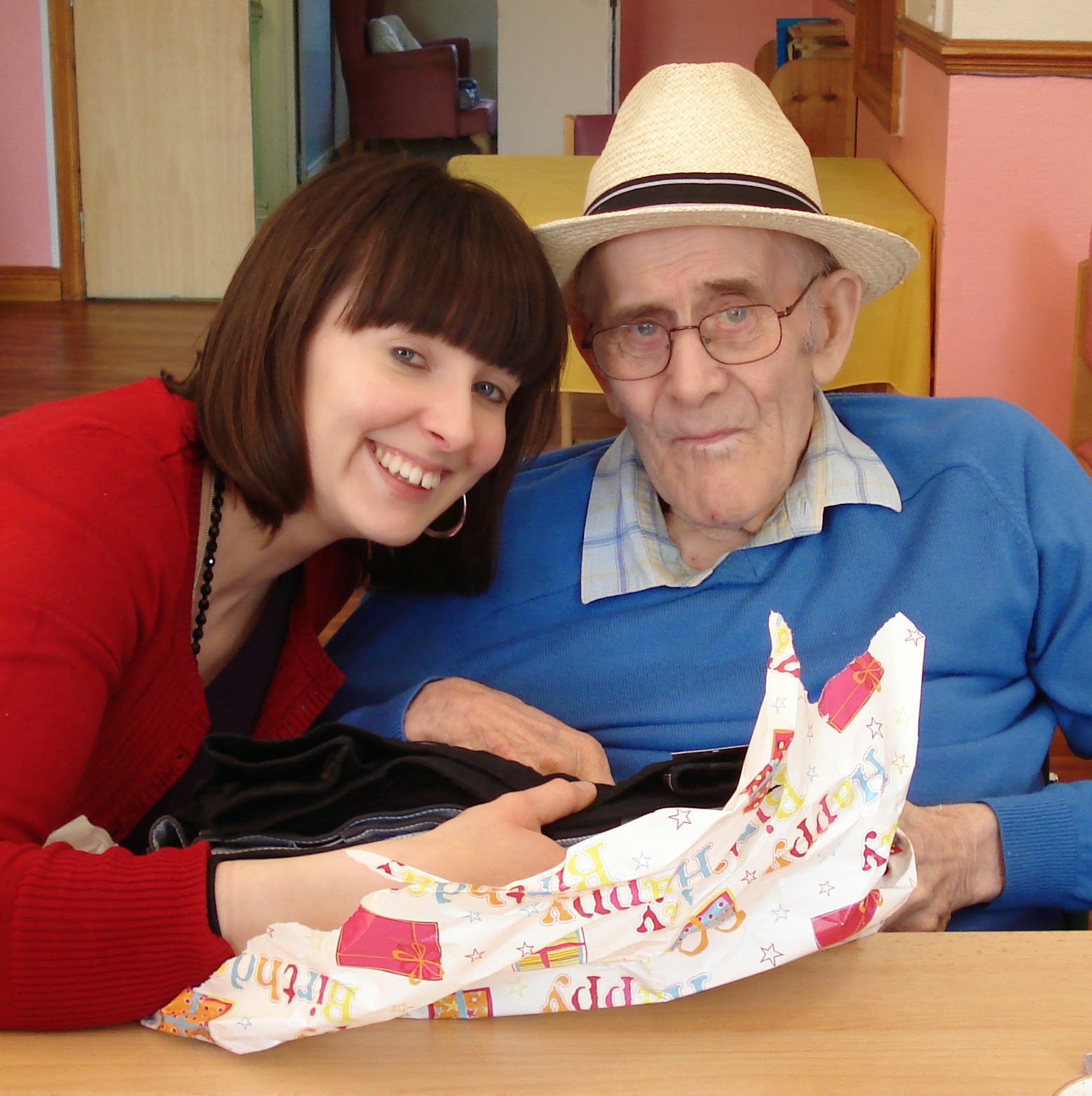
Dad's birthday in 2010
As regular readers will know, my dad spent 9 years in 3 different care homes. That’s 9 birthdays that you might be forgiven for thinking were difficult to even contemplate celebrating, given that dad was living in a communal environment and over the years became very immobile and poorly, severely restricting what a celebration could actually involve.

Yet quite the opposite is true. We made the best of the situation we found ourselves in for three reasons:  

·       Firstly and most importantly for dad. He didn’t ask to have dementia, nor, given the choice (we weren’t) to live in care homes. He was never the biggest fan of his birthday but, that said, in my early childhood dad always had a cake, special meal, favourite drink, cards and presents, and frankly, there was absolutely no reason not to carry on with those celebrations as best we could.

·       Secondly, to make the most of family time together. Despite dad living in a communal environment and sharing his birthday celebrations with everyone living there, it was also a landmark date for us getting together as a family and in amongst all the other faces and events happening around us we still had quality time together as a family.

·       Thirdly, to create the happy memories and photos that we have today. This reason seemed less important at the time, we were simply living in the moment, but now that dad has gone it takes on a very different meaning.
 
The nature of dad’s birthday celebrations changed over those 9 years. To begin with we would take dad out, go to the pub and have a favourite meal and a pint, most notably for dad’s 80th birthday. I have a fabulous picture that I occasionally show during presentations at conferences of my dad enjoying his pint on his 80th birthday – a photo that for me really sums up living well with dementia.

Subsequent birthdays were spent at the care home. Dad had a swallowing problem for the last 4 years of his life which made eating out quite difficult. Food choices were very restricted for him on conventional menus, and given that his routine was to have his main meal in the middle of the day, options such as soup really weren’t going to be enough for a man who, gloriously, still had a very impressive appetite.

Just because dad couldn’t go out for a meal, however, didn’t mean that we couldn’t all eat together. We would talk to the chef at the care home prior to dad’s birthday and as a family we would each choose something to eat with dad. A family table would be set in the dining room and we’d enjoy a two course meal with dad. Sadly we never had much success thickening beer, and dad didn’t like the taste of wine in the last few years of his life, so the toast became fruit smoothies.

Generally before lunch we would open presents and cards, not least because dad would often be too sleepy to enjoy them in the afternoon. A standard present was always a new CD, and that would usually be played in the afternoon. As dad liked lots of classical music, it was very easy for us all to get into the spirit of an afternoon nap! I would often be propping my eyes open sewing name tapes into dad’s new clothes (another standard birthday present), before cake arrived.
Dad's 2011 birthday cake
Like many care homes, the homes my dad lived in always gave residents a freshly baked cake for their birthday, complete with candles to blow out. I would also make a cake, and we would share tea and cake with dad mid-afternoon, and then by 4.30-5pm the evening tea would arrive – usually soup, sandwiches and a dessert.
 
Suffice to say, then, that dad’s birthdays were pretty much crammed full of food, along with lots of photos, singing, laughter, smiles and jokes. I would always ask dad if he liked his presents, and it was always his prerogative to say he didn’t – a little joke between us that always made me smile.
 
Birthdays, with the exception of dad’s last birthday, were always happy events, so much so that as I write this I have a smile on my face. Sadly, for dad’s last birthday, he was very poorly and would pass away less than two weeks later. Those photos aren’t happy ones, and those memories have a very strange mix of emotions attached to them. Gratitude and relief that dad’s last birthday wasn’t spent in hospital, huge thanks to the wonderful staff at the care home dad had just moved into for their help in getting him out of hospital and the huge effort they made on the day with decorations and a beautifully decorated cake (that unfortunately dad was too poorly to eat), but also recollections that no matter how much we tried to lighten the mood, we knew that dad wouldn’t be with us much longer.
 
Although those memories may be the last ones I have of my dad’s birthdays, the happy times we had in earlier years outweigh the sadness, and I hope that they give other families some inspiration to continue to celebrate and enjoy special occasions with their loved ones. Living with dementia, and indeed living in a care home, doesn’t have to end all hope of putting the ‘Happy’ into ‘Happy Birthday’.
 
Until next time...
Beth x


You can follow me on Twitter: @bethyb1886


Monday, 30 March 2015

Reablement for people with dementia

As we approach Easter, a time associated with rebirth, new life, possibility and opportunity, I have found myself thinking about how this correlates with the experience of living with dementia. Historically, a diagnosis of dementia has been seen as a death sentence to endure and suffer, but since that doesn’t tally with how I look back on the years I had with my dad during his dementia, I have become increasingly interested in the concept of reablement.

Reablement is generally associated with helping a person to regain the ability to look after themselves following an illness or injury. You are most likely to see services dedicated to reablement for people who are recovering from trauma (I distinctly remember the wonderfully holistic package of reablement given to my half-brother after he had a road traffic accident), or a stroke, and possibly even for people who are recovering from mental illness or addiction.

I would frame reablement as help to complete essential tasks of daily living, support to pursue hobbies and interests that are mentally and/or physically challenging, and opportunities to grow and develop. For my half-brother, I recall a residential reablement centre he went to after being discharged from hospital where he was supported to look after himself (cooking, laundry, personal care etc), return to participating in the things he enjoyed prior to his accident (hobbies and activities that were important to him), learn new skills, and plan for the future to help him prepare for living independently, getting out and about and returning to employment. He received physiotherapy, occupational therapy, counselling and there were wider family support services.

All of which begs the question, why aren’t the principles of reablement more closely associated with dementia? To put it bluntly, since dementia is a terminal disease, I suspect people with dementia are seen as being unlikely to benefit from a service that supports and encourages independence and autonomy, when traditionally dementia is associated with a degeneration into complete dependence and a loss of voice and identity.

Obviously I’m not questioning the terminal nature of dementia; my dad had vascular dementia on his death certificate. Nor am I suggesting that as dementia progresses a person doesn’t become more dependent -  I know from my dad’s experience that he became totally dependent on 24/7 care, hence why he was in a specialist dementia nursing home for over 8 years.

But behind all of this there are some key variables: 

1.      There is no set pathway for deterioration, everyone experiences this differently and in different time scales. I don’t really support the categorisations of early, middle and late stage dementia – to me these junctures are too specific and not reflective of the fluctuations in the day-to-day life of a person with dementia. Surely aiming to help a person to have the highest level of functioning for as long as possible can only be a good thing?

2.      No matter how advanced a person’s dementia is, there are opportunities for participation in everyday life, it's just that we often don't see these or have time to help them happen. Key examples from my personal experiences are my dad occasionally wanting to take the spoon and feed himself his pureed meal in the last year of his life, or finishing a song in perfect time to the music when he otherwise had virtually no speech. These achievements came about through perseverance, patience and offering encouragement.

3.      We are never going to know what people with dementia are truly capable of if we don’t actually put in the services, like we have for people who experience trauma or stroke, to actually see what is possible. How do we know reablement services aren't just as effective as any of the drugs we currently have , or might have in the future, to treat symptoms or slow down the progression of dementia? Admittedly there have been a few areas of the UK offering reablement to people with dementia, but it certainly isn’t a mainstream service.

Sadly my dad never really experienced any form of official reablement. At the point he was diagnosed with vascular dementia, following ten years of mini strokes and then one much larger stroke, his quality of life and abilities had deteriorated very rapidly. As a family we had been trying to support him but we really didn’t understand what was happening to him, and the health and social care professionals in his life hadn’t been proactive enough to grasp the bull by the horns, diagnose, explain and, crucially, offer dad and us the support we needed.
 
Enabling dad to have maximum independence, occupation and enjoyment in life was pretty much impossible once he was confined to hospital and then moved into the first of the three care homes he would go on to spend the last nine years of his life in. We had some small victories over the years, largely stumbled upon through pure chance – examples include discovering the power of music therapy, the joy of food and eating and the wonderment of connecting with the natural world – but nothing that really fits how I would interpret reablement if I had the chance to live those 19 years of my dad’s dementia with him again.
 
My top tips for reablement success for a person with dementia would be:

1.      Offer reablement in the person’s own home - the type of residential centre my half-brother went to isn't going to be the right model for the majority of people with dementia given the confusion and anxiety a new environment could cause. Equally hospitals, however dementia-friendly they are (and the one my dad was in really wasn’t), don’t offer the familiarity, calmness, opportunities for exploration and expression or the personal touch of home.

2.      Involve a multidisciplinary team of professionals, most notably people who are from the allied health professions, all of whom should be specifically trained in dementia and all of whom should take their lead from the person with dementia. Remember, professionals can learn from the person as well as imparting their own knowledge.

3.      Think out of the box. Is there technology that can help? What about the latest guidance on dementia friendly environments, has this been translated to the person’s home? Away from health/social care, are there individuals within the local community who can provide pastoral or occupational support, visiting or enabling the person to get out and about to enjoy hobbies/activities? Going further, can the person be enabled to get involved in community work/volunteering/awareness raising/public speaking etc – there are some fantastic peer support and mentoring services than can encourage such activity for people who feel it is right for them.

4.      Belief in the possibilities of reablement both for the person with dementia and those who are supporting them – be they family members, friends, neighbours or health and social care professionals – is vital. This means moving away from the historical or traditional views of dementia and seeing the exciting possibilities of reablement and how it feeds into living well.

Alongside these tips, do take a look at this page on the SCIE website: http://www.scie.org.uk/publications/guides/guide49/dementia.asp
 
Interestingly from the perspective of the timely diagnosis agenda, reablement fits perfectly with the idea of catching symptoms early and maximising the person’s potential. Currently diagnosis is often just a label and a prescription – reablement offers something more tangible, providing strategies and opportunities to grow into that diagnosis and live well with it. It should be at the heart of good post-diagnostic support, and if it were, those of us who are doubtful of the merits of diagnosing earlier and earlier might see more justification for it if an accurate diagnosis can be made.
 
Reablement isn’t about giving people with dementia or their families false hope or denying the reality that dementia is still a terminal disease. What reablement offers is the chance to make the best of what we have and do something practical to underpin the message of living well with dementia. Without reablement, I think that there is a very real risk that we give up on people with dementia far too easily.
 
Until next time...
Beth x


You can follow me on Twitter: @bethyb1886


Monday, 16 March 2015

Dehumanisation in hospitals

I have many personal dislikes to language used in relation to older people or people who are living with dementia, but a particular phrase is the subject of this blog mostly because I think it says a huge amount about how the healthcare system sees the very people it is there to serve.

‘Bed blocker’ has become a commonly used phrase to describe a person who is medically fit to leave hospital, but who cannot return to their previous life – perhaps living alone in their own home – due to their personal care and support needs. People who are living with dementia, whether it’s diagnosed or not, are at particularly risk of longer stays in hospital and by default adding the unwanted stigma of being a ‘bed blocker’ to their already stigmatised life.

Such delays in hospital discharge are usually caused by our bloated health and social care systems arguing over who is going to assess, organise, provide and fund an appropriate care package. It is often exacerbated by health and social care professionals failing to communicate between themselves, external care providers, the person - the ‘bed blocker’ - and their family.

What is really lost when we talk about people who are in hospital for longer than they should be is that every ‘bed blocker’ is an individual with a rich life history, a home they are perhaps longing to return to, and immense confusion and frustration at remaining in hospital. No one is more greatly affected than the person who has been labelled a ‘bed blocker’, which is what makes this label all the more offensive.

As a frail older person with dementia in hospital you are largely powerless to decide when you leave, and to some extent, where you might go. Yes, you can discharge yourself, but many people don't have the physical or mental capability to do that, particularly in an environment that strips them of their identity and life skills. They may not be able to find their clothes and organise the transport needed to leave, let alone be able to access their bathroom and bedroom, prepare food and drinks or take medication once they are out of hospital.

The situation is particularly acute for people with dementia because they have increased care and support needs that are very specialised, and with our fragmented health and social care systems it can be difficult to agree, source and fund that specialist provision. The person themselves may not be able to make their own decisions, or possibly could but they don't have access to appropriate advocacy services, and if the person has a family, they aren’t always nearby to provide additional help.

These are older people who are frail and vulnerable, and yet they are seen as being in the way and wasting NHS resources, despite the fact that throughout their working lives they would have helped to fund the NHS. ‘Bed blocking’ has even become an argument for some people who are keen to promote euthanasia, a concept that I’m not sure could be any more dehumanising.

Technically, my dad was a ‘bed blocker’. The two inpatient stays he had whilst waiting for care home placements were lengthy – one stay was three months – and as he became more frail in the last few years of his life, he was admitted to hospital  from his care home with both chest and urine infections. As he was already in the social care system and with funding in place, he did at least have somewhere to be discharged back to, but the care home still had to assess him and agree to have him back.

We were more fortunate than many families whose ageing loved ones yo-yo between hospital and home, struggling in both settings, or who watch their loves ones deteriorating in hospital while they become pawns in funding assessments between health and social care services. Hospitals can be dangerous places for older people who are living with dementia, especially given hospital infection rates and staffing levels. Who would want to lay in a hospital bed day-after-day with only hospital food to eat and with an unbroken night’s sleep an impossible dream – it’s hardly a preferable choice is it?

Yet somehow the term ‘bed blocker’ makes it sound as if the person is actually deliberately blocking the smooth operation of the hospital by outstaying their welcome. It might be a simple term for a hospital manager to illustrate the capacity crisis in their service, or for a journalist looking for a headline grabbing phrase, but it remains about as far away from kindness and compassion as you could possibly get.

So can we ever get away from the term ‘bed blocking’?

Last Wednesday, 11 March, marked NHS Change Day, and although I didn’t personally get involved this year if I’d been creating a campaign it would have been around this issue. The NHS needs to get away from seeing people as a box to tick or a bed to empty. Integration (Joined-up thinking) may be a phrase even more overused than ‘bed blocker’, but I genuinely believe that the answer to many of the challenges the NHS faces with lengthy inpatient stays comes from the availability and funding of social care services.

When the fundamental issues of how and where we provide high quality care and support for frail older people are resolved, we may find we no longer have ‘bed blockers’. In the meantime, let’s stop giving the impression that patients are to blame for being in hospital beds and ditch this dehumanising phrase once and for all.

Until next time...
Beth x


You can follow me on Twitter: @bethyb1886

Monday, 2 March 2015

One million friends, but we need specialists too

Like many people who have supported the Dementia Friends initiative, I was delighted to hear the announcement that the target of creating one million Dementia Friends was recently reached.

Dementia Friends is the UK Government's initiative, in partnership with the Alzheimer's Society, to increase basic awareness of dementia within, initially, England but now also in Wales and Scotland. To become a Dementia Friend you undertake training, either in person or online, and are asked to commit to an action as a result of your increased knowledge of dementia. To become a person who delivers the training - a Champion - you complete a one day course and are then equipped with resources to go back to your community and hold face-to-face training sessions.

I trained as a Champion in May 2013, and although I wouldn't say that every aspect of Dementia Friends is perfect, its benefits should be recognised. Increasing dementia awareness, even at the most basic level, is generally a positive step forward. Likewise, giving people something to belong to by giving them a badge, and a real sense of joining a social movement for change is also a positive example to set.
Sporting my Dementia Friends badge
Some of the main problems with Dementia Friends have come from the name itself, which some people have misinterpreted as suggesting that people who become Dementia Friends then go out and befriend random strangers who are living with dementia. Equally, the idea that people are 'trained' gives the impression that this is comprehensive dementia training which replaces other forms of more in-depth, and potentially costly, education.

To be fair to those who have pioneered Dementia Friends, both of these common myths are roundly condemned by the official literature that accompanies the initiative, but never-the-less, I still encounter health and social care organisations who believe that giving their staff Dementia Friends training means they have trained them in dementia care. They have not.

Dementia Friends isn't without its critics, and equally its hardened enthusiasts. I sit somewhere in the middle. I like the basic concept, the positive way it's been embraced by people who have never even thought about dementia, and I am happy to wear my badge. Indeed it goes everywhere with me and has proven to be a great conversation starter.

But where to now? The next target is to create another three million Dementia Friends, which certainly demonstrates ambition, but while we increase the community-wide understanding of dementia, there remains a question mark over how much money is going into the specialist support that is desperately needed.

The training of health and social care professionals is still clearly not at the level it needs to be, and may be many years away from universal tangible improvements, no one really knows. The quality of training in health and social care settings is hugely variable, and the new Care Certificate will only go some way towards bridging that. The vast majority of training still never really gets to student's heart and soul in a way that will be utterly unforgettable, and will permanently improve their practice and inspire them to deliver the very best care. Such an impact is as vital for newcomers in health and social care as it is for those who have been working in these professions for numerous years.

For people who are living with dementia and their carer(s) and families, access to dementia support workers, befrienders and other associated facilitators and providers of support and information is patchy and their skills aren't universal, so if you happen to be assigned a hugely knowledgeable and empathetic individual that’s great, but you may very well never meet such a person. Equally, there is no national programme to offer training to people with dementia or their carer(s) in a bid to help them to live as well as possible throughout their life with dementia.

The idea of dementia coordinators to help those affected by dementia navigate the services they might want to access has long been muted, but again, this isn't universally available. There is an expectation that GP's coordinate, but you can't do that effectively in 10 minute appointments, and besides, many GP's would argue that they need more specialist training in dementia to take on such a role. 

Primary care and community (district) nurses are potentially ideally placed to provide specialist dementia support, especially in the case of community nurses who are visiting people at home. However, there is no national scheme to recruit and train the additional numbers of nurses who would be needed in order to provide this type of service to everyone who wants it, and besides, where would the money come from?

Then of course there are Admiral Nurses - specialist dementia nurses who are to dementia what Macmillan nurses are to cancer. Admiral Nurses have been credited with providing invaluable support to families affected by dementia, in some cases even saving carers from potential suicide, but they are not trained by the NHS or Social Care. Admiral Nurses are provided by Dementia UK - a charity who are dwarfed in matters of dementia policy and strategy by the Alzheimer's Society. 

Admiral Nurses are seen by many people as an expensive option, but evaluation exercises are starting to prove otherwise, and frankly even if they are an expensive option, if they provide the support that families need then I would suggest that in a compassionate society that’s aiming to lead the world in dementia care and support, it is a price worth paying.

The money that has been invested into creating the social model of dementia awareness (£2.4m is quoted in this press release announcing Dementia Friends, while Public Health England issued a call for advertising agencies to pitch for the ‘Dementia Movement’ brief in 2013) may have been well spent considering targets have been reached. It can only be hoped that our communities are enhanced by having this greater understanding of dementia. 

My fear, however, is that without the specialists to call upon for each and every person affected by dementia, the overall aim of enabling people to live well with dementia will be lost. I’m sure that life for my dad would have been improved through living in the age of one million Dementia Friends, but I also know that through the many difficult challenges we faced, the decisions we had no idea how to make and the questions we had that went unanswered, that families affected by dementia often need a bit more than just a friend.

Until next time...
Beth x


You can follow me on Twitter: @bethyb1886

Monday, 16 February 2015

B for Burden?

I vividly remember as a child the first major bereavement in my life. The sudden death of my maternal grandmother came as a huge shock to my whole family and left my mother utterly devastated. As a small child I had little concept of what this grief and shock really meant, but I do clearly remember my mother telling me that gran had always said that she, “Didn’t want to be a burden on her daughters,” like her mother (my great grandmother) had been to her sisters (my great aunts), and that she would at least be glad that her sudden death had ensured this.

I never thought much more about the issue of burden at the time. What it really was and what it meant was of little interest to me then, but it would come into much sharper focus in my teens and twenties as my dad lived with dementia. Many people expressed their belief that my dad’s dementia must have been a huge burden on my life and that of other family members, with my peer group in particular finding the whole notion of having a parent with dementia just too burdensome to contemplate.

At the time, as ‘friends’ dropped by the wayside, I remember thinking that one day they may be walking in my shoes. Would it simply be the case that as adults with their own life, job, partner and children of their own, that their parent(s) would become a burden that they just didn’t have the time and energy for? The whole concept of burden is incredibly interesting, not least because technically we are a ‘burden’ to someone from the moment we are born until the moment we die.

Looking at burden through that technical viewpoint would mean that when we are born we are a ‘burden’ to our parents, because without their care, which takes a considerable amount of time, effort and money over many years, we are unlikely to survive to even make it to adulthood. We are a ‘burden’ to our teachers who must educate us, and we are a ‘burden’ to any healthcare professional who is charged with helping us in the face of serious illness or injury.

As young adults we often become very focused on our own lives, and of making a ‘new’ life that moves us away from that model of our early family existence and into being an independent entity. But we don’t stop being a ‘burden’ – technically if we have an employer they could consider us a ‘burden’ given the rights and protection employees have under employment law. Likewise in our private lives, any partner we may have could find domestic daily life with us has elements of being ‘burdensome’. We may even become a ‘burden’ on the state if we need financial or housing assistance - anyone can fall on hard times.

In adulthood many of us also start to take on additional ‘burdens’ in the form of having children and beginning the whole cycle of ‘burden’ from a different perspective. By the time our parents age, many people simply don’t have the time or energy for another ‘burden’ in their life.

But what is this ‘burden’ exactly? Is it financial? Is it emotional? Or, when related to someone older, or someone ill, is it about confronting our own mortality? I suspect that for many people it is a mixture of many facets. Yet interestingly, despite the effect my dad’s dementia had on my life, I never saw my dad as a burden. In fact quite the opposite. I saw him as someone to love and care for in much the same way that he had loved and cared for me. It was a role reversal, but not a burden.

Of course not everyone views the concept of burden in the same way. In two recent meetings I attended the word burden came up twice. In one instance it was in relation to ‘carer burden’, a method of describing the effects of being a carer to a person with dementia. The other example came in a discussion about dementia, where a contributor suggested that if they were to develop dementia they would like the option of euthanasia to make sure that they didn’t become a burden to their family.

The point about euthanasia is too big for this blog post so I will tackle it at a later date, but the overarching theme from both of these references to burden is the perception that:

A) Caring for a person with dementia is a burden and

B) That the burden only ends when the person dies (and potentially not even then, given the problems that can arise when you are no longer a carer). This then leads into the thorny area of debating if we should hasten the death of the person.

This is a familiar portrayal, and for some people these feelings of burden are their reality – I wouldn’t seek to deny that at all. But I believe we do people with dementia and those caring for them a huge disservice if we only view a life with dementia, and a life caring for a person with dementia, through this stark, dark portrayal of burden.

My experience, and I only speak for myself here, is that rather than being a burden, my dad taught me more in the 31 years I had with him than I suspect I will learn in the equivalent next 31. Dad gave me so much, and showed me the way to use my life and his legacy to make a real and lasting difference to the lives of others. So, not so much a burden as a joy.

When I talk now to the people in my life who I love the most, and they (sometimes) express their desire to never become a burden to me, my reply is that in my mind when you really love someone that love supersedes any burden. For me, looking at a caring role in the context of love rather than burden is an infinitely more meaningful portrayal.

Until next time...
Beth x


You can follow me on Twitter: @bethyb1886

Monday, 2 February 2015

A moving experience

Moving into a new home is always stressful. I spent most of 2014 trying to move house, and I can testify to why it is generally considered to be one of the most stressful life events, alongside bereavement, divorce, major illness and losing your job.

Fortunately, at the end of our very protracted move was a lovely new home, and even unpacking became strangely exciting – the thrill of finding new places to keep treasured possessions. Some items had to be given to charity shops, but the vast majority of the things that we have accumulated over the years came with us. From the day we moved in we were able to close our front door to peace and quiet, our own space, our own choices of food and entertainment and a life of domesticity that is exactly how we want it to be.

There is a another kind of moving house, though, that is altogether different. A move that is more traumatic than most and yet remains shrouded in stigma: moving into a care home.

It’s the kind of move that is often not of the person’s choosing (although sometimes it is), where your personal ‘front door’ is just your bedroom door, where peace and quiet and sometimes even privacy are at a premium, where you live in extremely close proximity to numerous other people, and where complete personal choice around food, entertainment and daily life isn’t the norm for everyone. Perhaps even more significantly though, it is a move that doesn’t involve packing up every item you have accumulated over the years, but instead forces you to choose a select group of possessions – only as much as will fit into your bedroom.

As if the stress of the move itself isn’t enough, a move into a care home often also brings with it elements of those other most stressful life events for either the person or their immediate family.

·       Bereavement:  As I wrote about in my blog post ‘Decisions, decisions’, care homes are perceived by some people as being ‘God’s Waiting Room’. I vividly remember in one of my dad’s care homes, a new resident arriving on the morning when a much loved resident had just passed away after a short illness. Although the new resident’s arrival had been planned for some time and their room was in a different part of the home, there was something very thought-provoking for that family: they were settling their loved one in as the undertakers were arriving to collect the deceased. If nothing else, it reminds you of the fragility of life. 

·       Divorce: For some couples who have been together for most of their lives, the day one of them needs to move into a care home and the other remains in the family home is one of unspeakable heartbreak. In some ways it could be considered even more upsetting than divorce because it is almost always a decision forced upon the couple, where neither wants it to happen and in any other circumstances neither would ever instigate it. No matter how many hours you go on to spend in that care home with your partner, you no longer live together:  your bed at night and your table for breakfast in the morning are now just for one.

·       Major illness: This is one of the main reasons a loved one moves into a care home, and it is often the fact that that illness has progressed that makes the move necessary, certainly in the case of a person who is living with dementia. For many families this can also go back to the point about bereavement, with many relatives feeling a huge sense of loss.

·       Losing your job: If you’ve been caring for a loved one who now needs specialist residential care, or indeed you can no longer cope as a carer, your loved one’s move into a care home - however much it may be needed - will permanently alter your way of life. You effectively lose your job as their primary carer overnight. For some people that may be a huge relief, but for many others it can leave them with feelings of hopelessness, lack of purpose and huge anxiety about how their loved one is being cared for in the care home.

Taking all of that into account, it puts the stress of the average house move - however stressful you think it is - into context. Moving into a care home isn’t just about changing your physical environment and leaving behind many of the items you have been surrounded with over the years; it also changes relationships and has an emotional element to it that you only really appreciate once you find yourself in that situation.
 
In many ways, I had that emotional toll softened by the fact that for the 3 moves my dad had into 3 different care homes over a 9 year period, each one meant a release from hospital, which was an infinitely more impersonal, regimented and clinical environment than any of those 3 care homes were. Had moving into a care home meant dad walking out of the family home, getting into a car and us driving him to a care home, it would have been far more emotionally difficult.
 
In my dad’s case the first move into a residential care home was possibly the most upsetting for him and for us – it came following a decision by dad’s care team that he couldn’t return home from hospital as he was considered at that time to be a danger to himself and others. The upset, however, was largely because of a fear of the unknown. We certainly weren’t sorry he was leaving hospital, and neither was dad.
 
The second move came after another spell in hospital, only this time dad had been there 3 months and lost half of his body weight. We just desperately wanted him to be in a more homely environment and be properly fed – it may sound a very basic aspiration but believe me, we were truly at our wits end with hospital care. The third move came at a time when dad was near the end of his life, and this time our desperation was for him not to die in hospital but instead to be somewhere as close to a home from home as possible.
 
And that’s the point, care homes really can be a lovely home from home if you are fortunate to find a good care home; a place where your loved one is happy and where together you make new friends that help you celebrate the happy times and comfort you in the sad ones. There are lots of negative stereotypes about what motivates families whose loved ones move into care homes, but being part of a care home community truly can be an enriching experience and, even if you are only an occasional visitor, it can be ‘Time well spent’.
 
For anyone feeling anxious about the impending move of a loved one into a care home, or indeed is feeling the emotional fallout (particularly guilt) after such a move, this Facebook status update from a lovely lady whose mum has just moved into a care home will hopefully make you smile as much as it made me smile when I read it:
 
“Just love the fact that I turn up to take mum out today and she tells me she can't because her friends will miss her, and then tells me to go home because she's busy”
 
Until next time...
Beth x


You can follow me on Twitter: @bethyb1886


Monday, 19 January 2015

An elephant never forgets... but sometimes humans do…

So here we are in 2015, with all the usual hopes for improvements in services and support for people with dementia and their families. It's tempting to write my first blog of the year on what needs to happen to enable everyone with dementia in the UK to live well, but I want to kick off 2015 by transporting you to South Africa where I was incredibly fortunate to spend last Christmas and New Year.

I had never travelled so far before, or had such a long holiday - well, carers generally don't do they? The purpose wasn't primarily about sun, sea or sightseeing, but to spend time with my partner's family, particularly his parents - the other elements came as an added bonus.
Spotted on my Kruger Park Safari
Foremost in my mind was a plan to put my work to one side, leave my campaigning and awareness raising in the UK, and switch off from everything related to dementia. It's been such a huge part of my life, both personally and professionally, for as long as I can remember so a complete break seemed a great idea. What I discovered, however, is that it's amazing how the things you are really passionate about seem to find you, even in distant lands. 

There I was browsing in a shop in a rustic lifestyle centre near a rural African town when I discovered small purple packages bearing the message:

'An elephant never forgets... but sometimes humans do…'.
An elephant never forgets... but sometimes humans do...
Inside the packages were little necklaces and the following explanation: 
"Creating awareness for Alzheimer's and Dementia
An initiative by Red Bush Jewellery (www.redbushjewellery.co.za) to create awareness of Alzheimer's... the proceeds of the sale of these necklaces will go to The Living Cornerstone facility based in Sedgefield, Western Cape, South Africa, which specialises in the care of these people (www.thelivingcornerstone.co.za).
Alzheimer's disease damages the brain. It causes a steady loss of memory and how well you can think and do your daily activities.
It is a debilitating disease for the sufferer as well as for his or her family and caregiver. It is not easy to accept that your loved one will be there in body but not in mind. It is hard to think that someone you have known all your life will eventually not know who you are.
The Living Cornerstone is there to help families cope with the inevitable, to lighten the load and provide a secure environment where sufferers can be cared for in a loving, stimulating, homely atmosphere, a real home-from-home ambience."
My elephant necklace - Raising awareness of dementia in South Africa
Admittedly the language and in particular the use of the word 'sufferers' isn't reflective of current thinking, but putting that to one side, everything about this made me smile. There, in the heart of rural Africa, someone had decided to do their bit to raise awareness of dementia, and I can only imagine just how vast that task is.

Everything in South Africa feels huge - sweeping landscapes, lakes and rivers as far as the eye can see, towns and townships that spread out before you in what feels like a never-ending picture. And I only saw a tiny fraction of what this country, with a population of over 52 million people and a land area of over 1.2 million square kilometres, actually consists of. 

Seeing the way many of the poor people live my mind was inevitably draw into wondering how on earth you would begin to support a relative who is living with dementia when even getting clean water is a daily struggle. Awareness and understanding of the different forms of dementia, never mind accurate diagnosis, is likely to be alien to most people. The effect of that on a person with dementia, when they are unlikely to know what is happening to their brain and potentially are subjected to a lot of prejudice, misinformed beliefs and experimental ‘cures’ is likely to be about as far removed from ‘living well’ as we could possibly imagine.

That viewpoint was reinforced during a conversation I had with a lovely lady from Swaziland. She asked me what I did for work, and I began by telling her about my dad. Despite speaking perfect English she had never encountered the word ‘dementia’ and asked me what it was. In explaining to her I discovered that she didn’t know that a person’s brain could undergo these changes, or of any similar disease or condition going by a different native or traditional name.

All of this just reminded me that it's easy to live in our little bubble of heightened dementia awareness, diagnosis targets, battles over health and social care provision, and excitement at breakthroughs in research. We are informed (even if at times it doesn't feel like it), with treatments and therapies to fight for (albeit limited), and a standard of care that we expect (even if we don't always get it).

As the necklace packaging says, ‘An elephant never forgets… but sometimes humans do...’ Meant in the context of dementia awareness in a rural African area it is a priceless message. But it also has huge value in the UK too – as a reminder of how far we have come as an awareness-raising country, and how for so many other people around the world there is so much more that needs to be done if they are to ever live well with dementia.

Until next time...
Beth x


You can follow me on Twitter: @bethyb1886