Showing posts with label anniversaries. Show all posts

Monday, 15 April 2019

Experiences of loss

With over 200 blogs on D4Dementia now, some of them approaching 7 years old next month, I've decided to spend my 2019 year of blogging by re-visiting some of the topics I’ve covered previously, throwing fresh light on why they remain relevant, and updating them with some of my more recent experiences. This month, I want to look at loss.

Losing my dad

One of my most popular and shared blogs on D4Dementia is ‘End-of-life care: A very personal story’. I wrote the blog less than two months after my dad had died, and with my emotions still very raw I began the blog by saying:
"Planting up my father’s grave recently, I found my mind wandering back to our last few days with him, painful in so many ways and yet hugely comforting as well. Nothing is more important to me than knowing that we spent all day every day with dad during that time, that we were with him at the very end, and that he had what I would describe as outstanding end-of-life care."
I’ve been back to plant up dad’s grave many times since I wrote that blog, most recently last week to give it some spring colour as we marked what would have been dad’s 92nd birthday. That was the first time our daughter could really participate in the gardening, and my feelings watching her digging little holes and helping to arrange the plants are something I can’t quite find the words to describe. It’s the closest she will ever get to my dad, which is a huge sadness as I know my dad would have adored being a grandpa and he never got that chance. The emotions may not be as raw now, but dad’s physical absence from our lives means that there will always be a missing piece in our family jigsaw. 

Loss from a distance

Very sadly I’ve had further personal experience of loss recently as my father-in-law passed away in South Africa, just 15 days before the 7th anniversary of my own dad’s passing and having lived and died from the same type of dementia – vascular dementia. Experiencing bereavement from a distance, having not been there to support my in-laws, as well as supporting my other half as he comes to terms with the loss of his dad, is the strangest mix of emotions, and the timing in particular has brought back many memories of my own dad’s passing. 

Distant bereavement means that you don’t have all of the practicalities to attend to, and you don’t feel remotely useful. Life is expected to carry on, and yet it isn’t the same and won’t ever be. Our parents shape our lives and the people we are – losing a figure so influential in your life is like having the rug pulled out from under you, and seven years on from losing my dad I have realised that you can never replace that carpet of stability and wisdom. All you can do is celebrate all that person gave you, and how they’ve helped you to become the individual you are.

Losing a new life

In my work life I draw on the strengths my dad gave me a huge amount, especially when dealing with any topic that involves loss. There is no denying the need to talk about advanced care planning, palliative and end of life care, loss, grief and bereavement, but while my personal experiences positively influence me as a trainer and writer they can also be painful to revisit in many different ways. 

One particular example of recent work, albeit ghost-written so I can’t signpost you to it as the author, was around how life story work can bring up thoughts and the associated feelings of bereavement(s) an older person experienced when they were younger. One of the most powerful ways I illustrated this was by drawing on the experiences of a lady I knew in her 80’s, who had heartbreakingly recalled a miscarriage as a young 20-something woman. 

At the time I never imagined this would resonate with me, but having had a miscarriage at 10 weeks last month I now know that an experience like that changes you. Other women older than me have told me they’ve never forgotten how they felt at the loss of the life they’d had growing inside them, and all I can really say is that in terms of pregnancy it reminded me of the title of a blog I wrote in 2014, ‘A loss of innocence’.

A loss of innocence not because I didn’t know miscarriages can happen, indeed my own mother had one before having me and I know many other women who’ve had miscarriages amongst my circle of family and friends, but because I will never view pregnancy, should it ever happen for us again, in the same way. As I said in my ‘A loss of innocence’ blog:
“Life is not and will never be as it was, and unlike many aspects of our existence this is something that we have no control over.”
For that lady in her 80’s recalling a loss of new life 60 years ago, as real then as the day it happened, is proof that living with loss is a lifetime’s work. Despite dementia taking many of this lady’s memories, it had left that one perfectly intact and able to torment her if the right care and support wasn't in place to help her overcome reliving those experiences whenever she saw a pregnant lady or a baby, having never been able to have children herself.

I’ve come to realise that any loss changes you, and perhaps the most important message about loss is that you don’t forget, and that’s ok. You can’t erase loss from your life however it has touched you; all you can do is find ways to acknowledge your loss and to live with it.

Until next time...
Beth x


You can follow me on Twitter: @bethyb1886
Like D4Dementia on Facebook

Monday, 9 April 2018

The rainbow of dementia

This week will mark what would have been my dad’s 91st birthday, and later on in April, the 6th anniversary of his passing. These milestones have left me reflecting on the last 19 years of dad’s life, how dementia crept into his life and year by year gradually overwhelmed him.

The picture painted of dementia in 2018 seems to have two distinct hues - the brightness of those who are living well, or as well as they can, and the darkness of those nearing the end of their lives, with the multiple physical health problems that I remember only too well. Yet as I think back over those 19 years, it was never as simple as two different hues for my dad.

If anything, it was much more like a rainbow, with the red roughly representing the beginning of my dad’s dementia (which was a gradual onset rather than a distinct change from one day to the next) and the violet representing the end of dad’s life. As the curves change colour, and reduce in size, so my dad’s dementia deteriorated, leaving him with fewer skills and more struggles.


Why a rainbow though you might wonder? It’s bright and cheerful and associated with the freshness and beauty that follows the darkness and rain. I certainly haven’t chosen it because I’m a 100 percent devotee of optimism where dementia is concerned. My positivity has always been tempered by stark memories of times that whilst difficult for me, were undoubtedly far worse for my dad.

I’ve chosen a rainbow because to me it represents balance: The brightness of the colours suggests something special and positive is possible at any point in a person’s dementia, but the reducing curves remind us that the struggles, or the paddling as my friend Kate Swaffer describes it, only becomes more pronounced.

If I think about my dad’s 19 years with dementia - certainly for the majority of the first 10 years - whilst the difficulties gradually increased, my dad had independence, looked after himself reasonably well for maybe five of those years, could read and write for the early years, follow TV programmes and sports, had a fairly good command of language, was able to participate in conversations, and certainly wasn’t slow in articulating his viewpoints. By 2018 standards, he would have made a good Dementia Diarist, a popular DEEP (Dementia Engagement and Empowerment Project) or DAI  (Dementia Alliance International) member, and an engaging public speaker (although my optimism on all of these fronts is tempered by knowing that my dad was a fairly private man by nature, so maybe wouldn’t have wanted to speak publicly).

Those are probably the red, orange and yellow years. By the time we get to the green and blue on the rainbow, dad’s in and out of hospital, and moving from a residential care home to a nursing home. For my dad, the key turning point is his larger stroke, and from that day confusion, communication difficulties, urinary incontinence, changed behaviour and a whole raft of inappropriate interventions (most notably antipsychotic medication) follow. My dad is becoming a much more stereotypical example of what society thinks about when it thinks about a person with dementia.

The indigo and violet years are characterised by further physical decline, with immobility, double incontinence and four years of dysphagia for my dad to cope with before the end of his life. This is the picture most people conjure up when they or a loved one are diagnosed. But as much as the ‘red’ years don’t go on forever, so most people with dementia don’t jump from ‘red’ to ‘violet’ either.

I am a great believer in seeing every face of dementia for what it is: The person living as well as they can in the red to green curves of the rainbow is giving hope to every single individual who has just been diagnosed or will be in the future. Without that hope, everyone just fast forwards to a picture of what 'violet' looks like, and that is only going to lead to more rapid deterioration with the added pain of potentially severe depression, hopelessness and even suicidal thoughts.

The person living in the blue to violet curves is never going to offer the same type of hope. They are coping with a greater array of physical health problems and are increasingly reliant on others for their care and support. Our perception is that brightness is fading, but what we learn from these individuals about the human spirit is perhaps even greater than their more articulate peers. Moreover, the qualities we find in ourselves from becoming caregivers represents invaluable, albeit sometimes very painful, life lessons.

Aside from my dad and the people I’ve known personally who are affected by dementia, I’ve met so many other individuals through my professional work who are living with dementia, coping (or not coping, and yes, sometimes suffering) and every single person has taught me something. As my dad took his last breaths I learnt about peaceful serenity. As I see a person living with dementia giving a conference speech, I learn about their strength to stand there and tell their story (often without notes, something I cannot do). As I see a person living with dementia in a care home trying to regain mobility after a broken hip, I learn about determination. As I read a book, a blog, or a social media post from a person with dementia who is laying bare their personal experiences, I learn more about living with dementia than I ever could from a textbook. As I see someone managing a few mouthfuls of food, and breaking out into a satisfied smile that they’ve outwitted dysphagia for one mealtime, I see a will to go on living despite the obvious struggles.

When my dad's life started to change, which in hindsight was when he began developing dementia, I had no idea we had 19 years ahead of us. As every year went by, we just tried to make the most of whatever situation we found ourselves in and give dad the best quality of life possible. I certainly don’t think we always managed that, and I dearly wish I’d known then what I know now.

Did my dad live well? Yes sometimes. Did he suffer? Yes sometimes. But when I reflect now, the fact that it’s a rainbow I gravitate towards, feeling an affinity with the brightness rather than the reducing curves, reminds me that although dad is gone we lived those 19 years together, and for all their ups and downs there was a beauty in the love that bound us together and that shines on.

Until next time...
Beth x


You can follow me on Twitter: @bethyb1886
Like D4Dementia on Facebook

Monday, 13 April 2015

Happy birthday to my dad

Today would have been my dad’s 88th birthday. By sheer coincidence, this blog is also my 150th on D4Dementia. How I have managed to bring these two milestones together I have absolutely no idea, but it makes this blog post extra special.

For me, today is more about celebration than sadness. That’s not to say that I’m not incredibly sad that I can’t spend the day with my dad, of course I am, although to be fair I think that every day not just on memorable dates. Every April since I began this blog, I’ve written a post about the milestones April brings for us as a family (2013: ‘Reflections on a life lived and a man loved’ and 2014: ‘A loss of innocence’), but this year I want to focus more on how we celebrated today when my dad was alive – happy memories that I will always cherish and that I hope might inspire other families. 
Dad's birthday in 2010
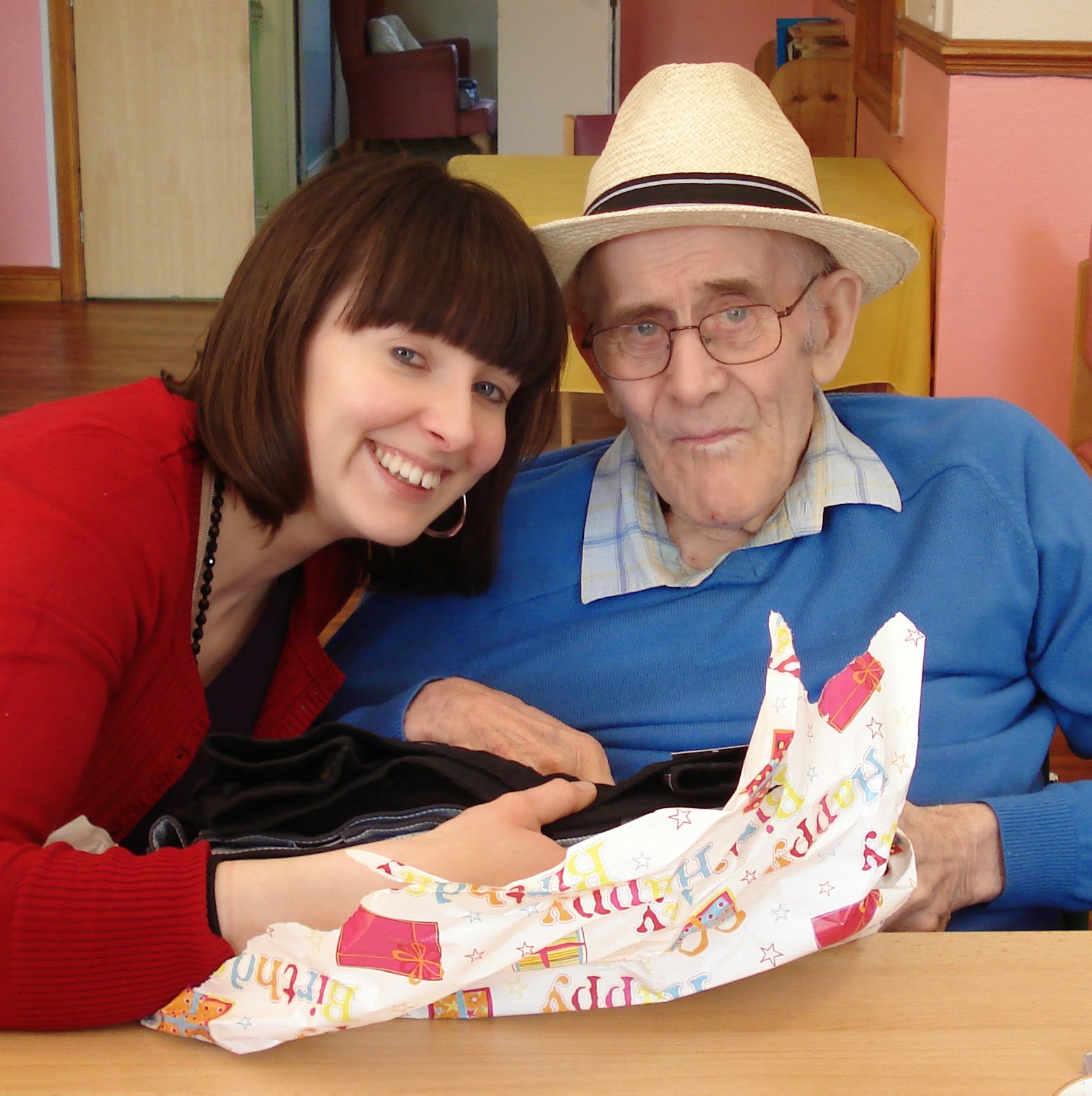
As regular readers will know, my dad spent 9 years in 3 different care homes. That’s 9 birthdays that you might be forgiven for thinking were difficult to even contemplate celebrating, given that dad was living in a communal environment and over the years became very immobile and poorly, severely restricting what a celebration could actually involve.

Yet quite the opposite is true. We made the best of the situation we found ourselves in for three reasons:  

·       Firstly and most importantly for dad. He didn’t ask to have dementia, nor, given the choice (we weren’t) to live in care homes. He was never the biggest fan of his birthday but, that said, in my early childhood dad always had a cake, special meal, favourite drink, cards and presents, and frankly, there was absolutely no reason not to carry on with those celebrations as best we could.

·       Secondly, to make the most of family time together. Despite dad living in a communal environment and sharing his birthday celebrations with everyone living there, it was also a landmark date for us getting together as a family and in amongst all the other faces and events happening around us we still had quality time together as a family.

·       Thirdly, to create the happy memories and photos that we have today. This reason seemed less important at the time, we were simply living in the moment, but now that dad has gone it takes on a very different meaning.
 
The nature of dad’s birthday celebrations changed over those 9 years. To begin with we would take dad out, go to the pub and have a favourite meal and a pint, most notably for dad’s 80th birthday. I have a fabulous picture that I occasionally show during presentations at conferences of my dad enjoying his pint on his 80th birthday – a photo that for me really sums up living well with dementia.

Subsequent birthdays were spent at the care home. Dad had a swallowing problem for the last 4 years of his life which made eating out quite difficult. Food choices were very restricted for him on conventional menus, and given that his routine was to have his main meal in the middle of the day, options such as soup really weren’t going to be enough for a man who, gloriously, still had a very impressive appetite.

Just because dad couldn’t go out for a meal, however, didn’t mean that we couldn’t all eat together. We would talk to the chef at the care home prior to dad’s birthday and as a family we would each choose something to eat with dad. A family table would be set in the dining room and we’d enjoy a two course meal with dad. Sadly we never had much success thickening beer, and dad didn’t like the taste of wine in the last few years of his life, so the toast became fruit smoothies.

Generally before lunch we would open presents and cards, not least because dad would often be too sleepy to enjoy them in the afternoon. A standard present was always a new CD, and that would usually be played in the afternoon. As dad liked lots of classical music, it was very easy for us all to get into the spirit of an afternoon nap! I would often be propping my eyes open sewing name tapes into dad’s new clothes (another standard birthday present), before cake arrived.
Dad's 2011 birthday cake
Like many care homes, the homes my dad lived in always gave residents a freshly baked cake for their birthday, complete with candles to blow out. I would also make a cake, and we would share tea and cake with dad mid-afternoon, and then by 4.30-5pm the evening tea would arrive – usually soup, sandwiches and a dessert.
 
Suffice to say, then, that dad’s birthdays were pretty much crammed full of food, along with lots of photos, singing, laughter, smiles and jokes. I would always ask dad if he liked his presents, and it was always his prerogative to say he didn’t – a little joke between us that always made me smile.
 
Birthdays, with the exception of dad’s last birthday, were always happy events, so much so that as I write this I have a smile on my face. Sadly, for dad’s last birthday, he was very poorly and would pass away less than two weeks later. Those photos aren’t happy ones, and those memories have a very strange mix of emotions attached to them. Gratitude and relief that dad’s last birthday wasn’t spent in hospital, huge thanks to the wonderful staff at the care home dad had just moved into for their help in getting him out of hospital and the huge effort they made on the day with decorations and a beautifully decorated cake (that unfortunately dad was too poorly to eat), but also recollections that no matter how much we tried to lighten the mood, we knew that dad wouldn’t be with us much longer.
 
Although those memories may be the last ones I have of my dad’s birthdays, the happy times we had in earlier years outweigh the sadness, and I hope that they give other families some inspiration to continue to celebrate and enjoy special occasions with their loved ones. Living with dementia, and indeed living in a care home, doesn’t have to end all hope of putting the ‘Happy’ into ‘Happy Birthday’.
 
Until next time...
Beth x


You can follow me on Twitter: @bethyb1886


Wednesday, 3 April 2013

Reflections on a life lived and a man loved


My dad
My dad
It seems hard to believe that April 2013 marks two very sad milestones for me and my family. This month will see us celebrating my dad’s birthday for the first time without him here. Less than two weeks later, it will be the first anniversary of his passing.

We often say how ‘time flies’ – well the first year without my dad has vanished in tears, memories, hopes, ambitions, achievements and still an almost overwhelming sadness that he isn’t here to share in my life. Without my dad’s courage, strength, love, determination and inspiration I wouldn’t be writing, blogging, speaking, advising and campaigning in the way that I am.

I’ve written before about my dad’s legacy. My desire to share his story - our story - and use the experiences we had together to try and make things better for the many families who are supporting a loved one with dementia. More than anything I wish you could all have met my dad – although I doubt he would agree, since he was generally a very private man who never sought the limelight. To me he was an example of dignity, grace, humour, kindness and insight into what living with dementia means that no words I could choose will ever accurately sum up. You just had to have known him, and I was very privileged to call him my dad.

I would like to think that the dates we will mark this month as a family will be more about happy memories and reflections on good times than dwelling on what we were going through this time last year, which still haunts my dreams and brings tears to my eyes. In truth, however, I really don’t know how we will feel and how the emotions will affect us. Bereavement is a strange beast – it can allow you to live in relative happiness one minute, then plunge you back into deep sorrow, longing for the person you have lost and taunting you with that precious wish for just one more day with your loved one.

I have thought long and hard about what losing a parent means, and how you can possibly move forward after that. When half of the partnership that created you, dictated your DNA, and in my case gave me a happy, stable and loving childhood filled with cherished memories, is taken from you, my view is that it breaks a bond that can never be replicated or replaced. The love you feel cannot be transferred to someone else. Losing a parent leaves you with an emptiness in your life that you will never fill.

As anyone who has had a good relationship with their parents will know, from an early age you come to rely on their guidance and wisdom, the care they show you, the support they give you and the unconditional love they surround you with. No one else celebrates your successes like a proud parent, and no one is ready to pick up the pieces when you make mistakes like a loving mum or dad.

I feel immensely sad that my dad won’t be by my side to see me make my way in the world, develop my career, maybe get married. If I ever become a parent, he will never know the joy of being a grandparent, and sadly for any child I may have they will only be able to learn about my amazing dad from me, rather than having their own relationship with him.

What dad’s passing will never take away, however, is the memories I have of him, including the many happy times we had together during his dementia. It cannot take away all of his qualities as a human being that he shared with me through his parenting, and it will never take away my pride in him and in being able to call him my dad. His honesty, integrity, desire to help humans and animals alike, care and compassion is something the world needs far more of than it currently has.

They say only the good die young. Well my dad was 85, to me just a number since he certainly didn’t look it. Without the toll dementia took on his body I am certain he would have lived far longer, so in my mind he was a mere spring chicken at 85 years young. Surprisingly, maybe, I am not angry or bitter at his passing – I honestly believe that he felt he had given me everything I needed to go on in my life, represent and share his values and make him proud, and so he was able to take his rest.

Having dementia often meant huge struggles for my dad, and I will never truly understand how he bore them with such resilience and good humour. I would like to think that one of his coping methods was the hope that he had managed to inspire his youngest daughter to make sure that his experiences were not in vain. The promises I made to him in the days before his passing should have reassured him of that.

Although my dad was the catalyst for what I do, the beneficiaries are all of us. I hope that my dad’s gift to society will be greater understanding, support, insight, and ultimately improvement in the lives of everyone who he has left behind.

Until next time...

Beth x


You can follow me on Twitter: @bethyb1886